
Did US trade policy move cattle prices? The data says no
 Steven Jaffery: Oct 21, 2026
The local cattle market has found another gear since the big turn off across southern Queensland and northern NSW eased entering May, as some late autumn rainfall helped calm nerves and promote some pasture grow in the mildest start to winter that I can remember.
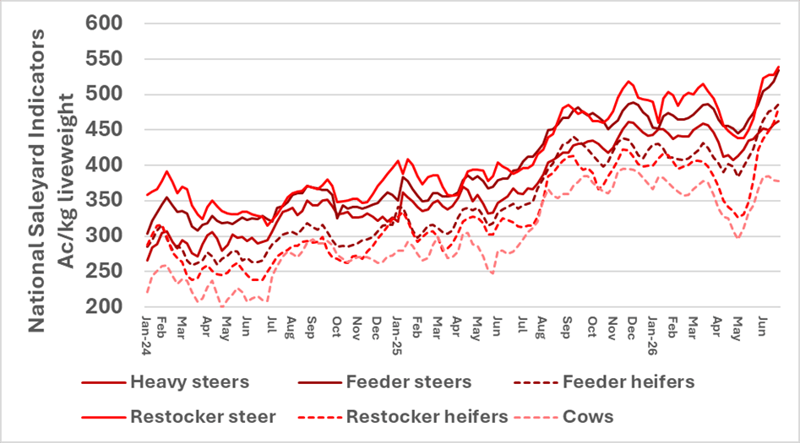
The rise in local cattle values has been quite phenomenal since the start of May:
Source: MLA
This chart shows MLA national saleyard indicators for major cattle categories in Ac/kg liveweight.
The rise has been driven purely by local factors; feedlots restocking after turning off early for China and some space only bookings falling over as prices rose with QLD producers taking advantage of the mild conditions and good pasture availability to add weight. Plus, we have had some genuine and sustained restocker interest for the first time in several years with pasture conditions as good generally as they have been since I started with Elders in March 2024. You can see in the performance of heifer categories which have narrowed the spread to their steer counterparts.
But our local cattle markets are at odds with what I’m seeing in global beef markets. On Friday, China officially announced that Australia had triggered its tariff rate quota with beef exports into China now subject to a 55% tariff, limiting our trade with China to fats and offal which are outside of quota thresholds.
Junie Lin, Expana’s Asia-Pacific expert said in her APAC beef report published Friday that “The broader Australian beef export sales pace levelled off under downward pricing pressure this week. While some sellers-maintained firm offers amid high cattle costs, a series of price-taker transactions surfaced well below mainstream market levels.”
Australia’s export sales to Asia were “instead directed predominantly toward Japan this week, with Korea's safeguard quota now tracking toward the 90% filled mark”.
With local beef margins being squeezed there was some talk of east coast plants responding by cutting shifts. The first signs of a local pricing adjustment were seen this week in direct to work quotes across QLD where rates eased 20-30c/kg pressured by increased availability of larger runs of company owned cattle out of northern QLD regions. Slaughter schedules across QLD have filled quickly for July and August booking slots are now filling.
Feedlots are also feeling the pinch from higher cattle costs with some operators considering leaving pens empty rather than filling them with cattle at current prices and coping red ink in 120 days. Angus feeders $5.80-6/kg (depending on where), Euro cross -30c/kg and flatbacks steady the Downs at $5.30/kg were commonly heard feeder quotes.
There have been some adjustments higher on 100-day forward contracts with Beef Central on Monday suggesting that 100 day grainfed contracts for October for hgp cattle had risen by 20-60c/kg to 890-930c/kg dressed weight (dw), with some talk of a 150-day contract at $10.50/kg dw, presumably for non-HGP cattle for China November delivery.
From a global market perspective attention will now turn to how Brazil reacts to it nearing safeguard levels into China. Expana reporting on Brazilian sales into China “A mid-June lull has firmly taken hold as the buying window for pre-quota Brazilian beef effectively shuts. Spot market activity ground to a near-complete halt this week since most buyers had already completed their strategic volume bookings ahead of the looming quota exhaustion.”
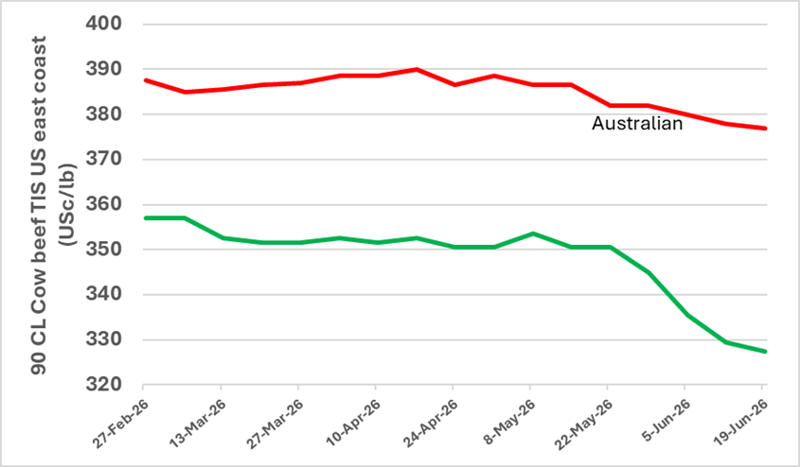
In recent weeks we have seen Brazilian exporters start to pivot towards the US market, lowering offers to win business.
Source: USDA
This chart shows 90CL cow beef export offers from major exporters into the US east coast.
Steiner on behalf of MLA, notes that, “imported beef prices were steady to modestly lower during the holiday shortened week (it was Juneteenth holiday in the US last Friday). Buyers are mostly focusing on inventory positions and needs for the next two weeks leading into 4th of July (Independence Day). This is the 250th anniversary, with plenty of celebrations planned. Between the long holiday weekend, the World Cup and the anniversary celebrations, market participants are hoping for a bump in demand. Oil prices have started to ease lower and consumer sentiment is expected to show some improvement.”
Despite some sectors feeling the pinch (QSR – Quick service restaurants), overall beef demand in the US remains on a very solid footing. For Q1 2026, the retail beef demand index hit the highest point in 25+ years, registering a +7% gain from the previous year and 15% gain from two weeks ago. Per capita beef availability (a key component in the index) is currently projected to be down just 0.2% in Q2, in part due to the big surge in imports.
With processing and feeding margins getting squeezed and global beef prices under pressure as Chinese beef market restrictions bite, we may be nearing the top of the recent rally.
On a positive note, for the Australian industry, JBS recently made a major decision to close a 2,000 per day cattle processing plant in Pennsylvania due to tight US cattle supplies. Large companies don’t make major decisions like this if the outlook for supply dynamics is favourable.
The USDA currently estimates only 33% of US pastures are in good/excellent condition about the same level they were in 2022 – there was significant cow herd liquidation. Despite record cattle prices, US ranchers won’t rebuild herds anytime soon.
The major threat to current pricing levels will be increased competition from Sth America beef in the US but also in secondary markets outside north Asia as it looks to divert the >100,000t per month it was exporting to China.
Richard Koch is Senior Analyst at Elders and works across the Elders national livestock network to provide its clients with the latest information and analysis on Australian cattle and beef markets contact [email protected] for more information.
For more information on the Asian beef market or for a sample copy of the latest Expana APAC Beef Report contact [email protected].

 Matt Dalgleish: Oct 20, 2026
There is a growing perception that Australian cattle prices are becoming increasingly volatile, with larger price swings becoming a more prominent...
 Ripley Atkinson