
2025-26 merino prices and volumes
The 2025-26 season has been one of those seasons where wool prices staged a strong rising price cycle, against a backdrop of a falling merino supply.
As usual the price changes were not uniform across all micron categories. This article takes a look at merino price and supply this season, with a look at price ratios for fine and broad micron categories.

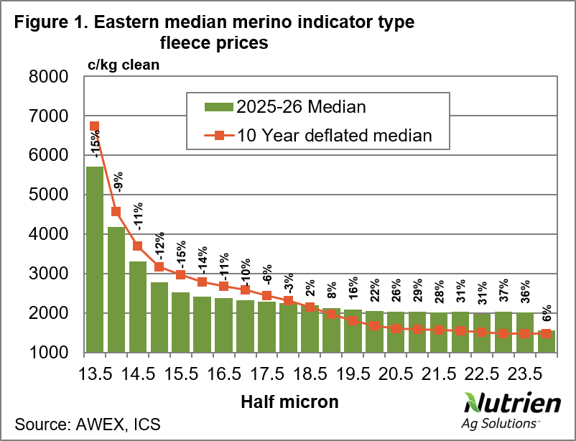
Figure 1 compares the median merino indicator fleece price for the 2025-26 season and the ten year median price (inflation adjusted), with the variation in the current season median price to the ten year median. The micron range runs from 13.5 to 24.0 micron, with most of the merino wool in the 16 to 21 micron range.
The 18.5 micron category price for this season was close to the ten year median, with prices for wool broader than 18.5 micron being well above the long term price (by 20-30%). Conversely prices for wool finer than 18.5 micron were all below the long run median prices, generally by 10-15%.
In Figure 1 the merino micron price curve continues to have an inflection point around 15.0 micron (in both series), where the gain in price per point of micron picks up significantly below 15 micron.

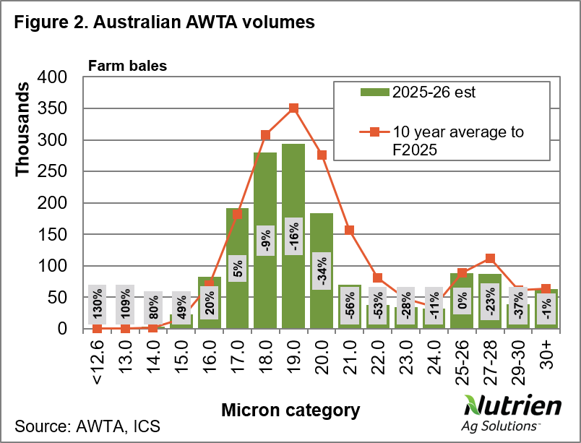
Supply, or really change in supply, is a major factor in influencing prices and relative prices in the wool market. Figure 3 shows the AWTA volume by micron category for the 2025-26 season (estimated for the full season from the July to May data) and the ten year average volume.
The variation between the 2025-26 season volume and the ten year average is shown for each micron category. Basically 17 micron and finer volumes this season were above the ten year average, with the 18 to 22 micron categories (mainly merino) all lower with the broader merino micron categories down by around 50%. Interestingly the crossbred category volumes are also substantially below the ten year average with the exception of the 25-26 micron category (which is mainly crossbred lamb wool) and the 30 micron and greater category (composite territory).

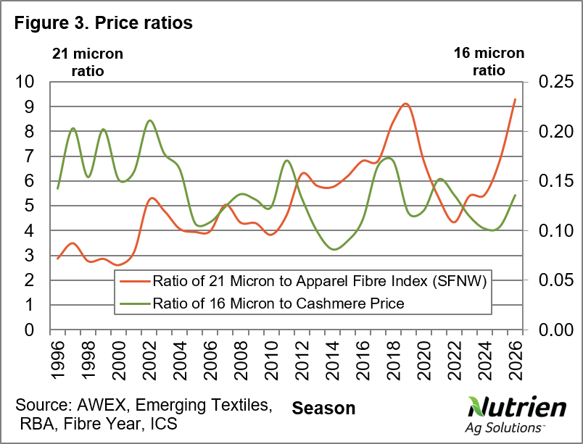
Putting price and supply together, the better performing merino micron categories in terms of price this season were supported by supply being lower in relation to the ten year average, and lower season on season. Australia is the big producer of merino wool, so changes in our production have a big impact on price. Figure 4 looks to put the prices levels for fine and broad merino in some apparel fibre context. The 21 micron price ratio to non- wool staple fibres (NWSF) is high, on par with the 2019 peak. Pushed higher by low volume, it is expensive. In contrast the 16 micron price, with relatively more supply, has had a middling to low price ratio to cashmere in 2025-26. From the perspective of the apparel fibre market 16 micron on average has been reasonable value.
Changes in supply are useful in helping understand some of the change in relative prices we see in the wool market. For merino wool this is convenient as we have the good data on hand for the Australian wool clip. For a more complete look at price we need to see what the non-wool apparel markets have done, with price ratios a short hand way of doing this. By this method the median prices for the season for broad merino (21 micron) are relatively expensive (matching feedback out of the supply chain) while fine merino (16 micron in this example) is around fair value compared to cashmere (not cheap or expensive).

Andrew Woods is the founder of Independent Commodity Services providing tailored insights to growers, brokers, traders and exporters, with decades of experience, Andrew’s analysis bridges practical farming knowledge and market expertise, with a strong focus on the wool industry.
The 2025-26 season has been one of those seasons where wool prices staged a strong rising price cycle, against a backdrop of a falling merino supply.
The past three months have reinforced that Australia has a predominantly grassfed production system with a grain finishing component that turns grass...
Every story we publish, every market wrap and weather update, is written with one audience in mind: you.