
A bit of applied futures theory
The latest Bureau of Meteorology (BOM) three months outlook points towards a weaker chance of a wet spring. This doesn’t mean that we’ll be in...
The latest Bureau of Meteorology (BOM) three months outlook points towards a weaker chance of a wet spring. This doesn’t mean that we’ll be in drought by October, but it’s worth looking at the probabilities and applying some futures pricing theory to cattle indicators.
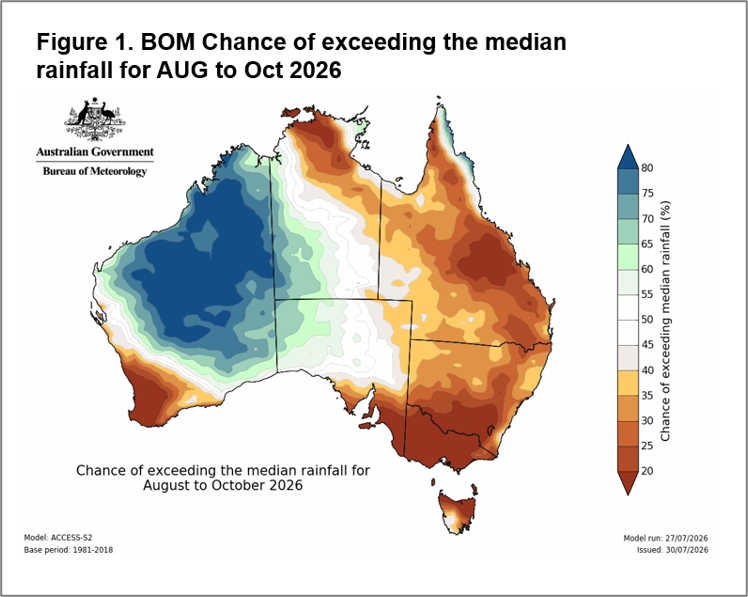
It is important that readers don’t take figure 1 on face value and delve a bit deeper into the probabilities on the BOM website. For example, the map suggests that there is a 20% chance or less of exceeding median rainfall from August to September at Wagga Wagga.

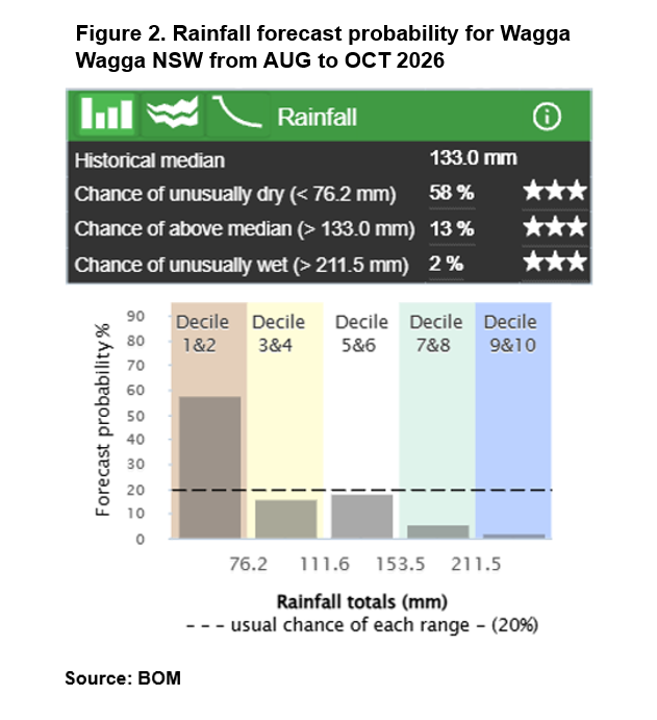
If you click on the Wagga Wagga on the map, we see the probabilities broken down into deciles, as shown in figure 2. This tells us there is a 58% chance of it being unusually dry, which BOM is telling us is less than 76mm from August to October. There is a 34% chance of rainfall being somewhere around median, as in deciles 3-6 with 76-153mm. Leaving an 8% chance of above 153mm, delivering a bumper spring.

Without checking all the sites available, and going off figure 1, we can apply these probabilities to much of the southern cattle zone which relies on spring rain not only for cattle feed but fodder reserves.
Applying these rainfall probabilities to price is the hard part, but we’ll do some back of the envelope calculations. Cattle prices usually fall in the spring, the average being 6% from the peak so we’ll use that as the base assumption.
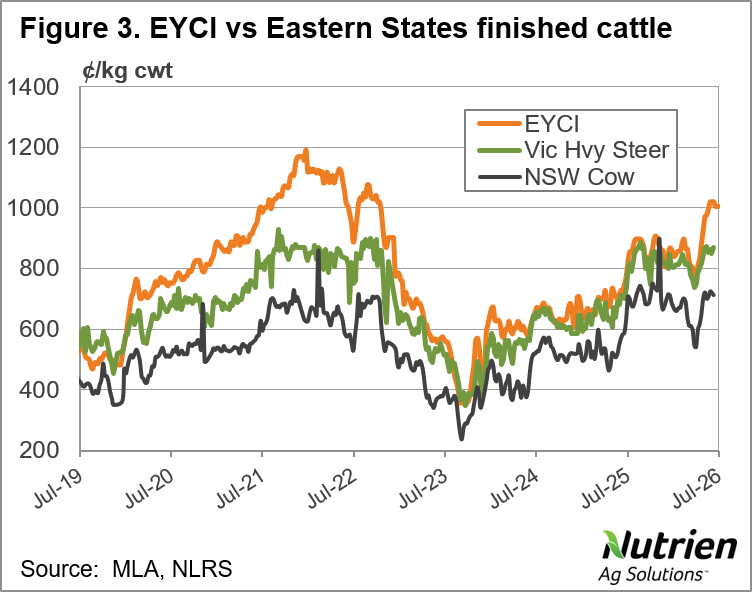
Using the 6% price decline as the baseline, and a 28% of rainfall being around median, we can put the Eastern Young Cattle Indicator at around 940¢, the heavy steer at 750¢ and cows at 660¢/kg cwt,

There is a 58% of unusually dry, which would give a price scenario similar to what we saw in 2023, which was a very large 39% decline for the EYCI. Falls were similar for heavy steers, and smaller for cows. A 39% decline gives an EYCI of 605¢/kg cwt, and we know that the spread between slaughter cattle and the EYCI closes when its dry, so we’d put the heavy steer price in at 600¢ as well.
The best case scenario rainfall would deliver prices similar or maybe a little better than what we are seeing this winter.
What does this mean?
Obviously, these probabilities and price scenarios are very broad, but if we take the weighted average of possible outcomes, we get an EYCI in October of 750¢/kg cwt, or 405¢/kg lwt. This is what would be called the fair price given the possible range of outcomes but is by no means a price forecast.
The BOM three-month outlook seems dire, but closer analysis is required.
We can look at rainfall probabilities and forecasts price movements under each scenario.
This then gives us a fair price based on probability, but it’s not a forecast.
Angus Brown brings over 20 years of expertise analysing Australian agricultural markets, and also runs a mixed farming operation in Hamilton, Victoria.
The latest Bureau of Meteorology (BOM) three months outlook points towards a weaker chance of a wet spring. This doesn’t mean that we’ll be in...
StoneX has released its H2 2026 Australian Cattle & Beef Market Outlook, which discusses the key trends, drivers and forecasts set to shape the beef...
The winners of the FY26 AuctionsPlus Awards have been announced, recognising the accredited assessors and agencies who have driven throughput and...