
A look at the implications of El Nino on rainfall
The mention of an El Nino has the scribes’ seeking forecasts and projections for agricultural commodities through production to price. This article...
The mention of an El Nino has the scribes’ seeking forecasts and projections for agricultural commodities through production to price. This article takes a look at what an El Nino forecasts, using rainfall from various regions since 1979.
Mecardo has covered the implications of El Nino to rainfall before in May 2023. The conclusions drawn then have not changed:
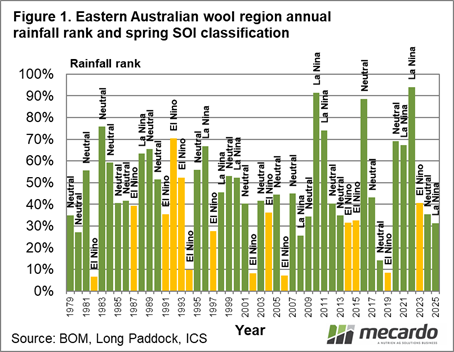
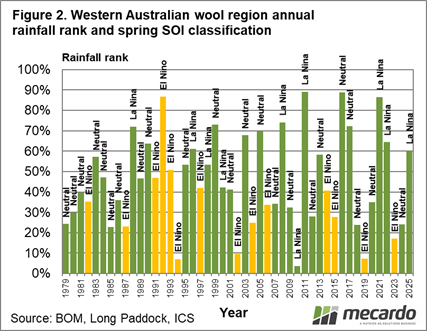
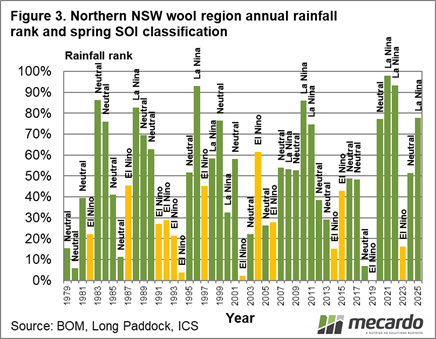
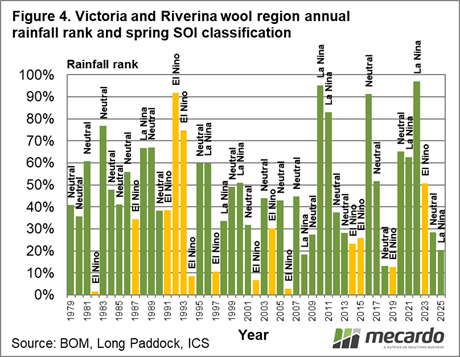
To illustrate these points, especially for El Nino, a series of four graphics are given which show the calendar year rainfall rank (compared to the preceding 40 years) from 1979 to 2025, along with the spring SOI classification for each year. This analysis does gloss over the impact that incidence of rainfall can have. The four regions selected are the sheep regions for eastern Australia, Western Australia, northern NSW, and Victoria/Riverina.

Figure 1 shows the calendar year rainfall ranks for the sheep regions in eastern Australia (weighted across the different regions) and the June to November SOI classification for each year. The El Nino years are highlighted. As a rule of thumb, a rainfall rank in the lowest two deciles is a major drought (such as 1994, 2002, 2006 and 2019). The point of this article is that a declaration of an El Nino has to be used with some care, as El Nino years can have up to median rainfall (1992 actually exceeded this level). Given the eastern Australian rainfall rank in 2025 was 31%, a median year with a rank around 50% would be a significant improvement.

Figure 2 repeats the exercise for Western Australian sheep regions. 1992 is the outlier with the balance of El Nino years in the lower half of the percentile range, some very dry and some quite comfortable.

In Figure 3 we head back east to northern NSW. It is a similar story with 2004 bucking the trend and having good rainfall during an El Nino. There are some horror years in terms of rainfall rank in this graph with 1994, 2002 and 2019 the worst.

Finally Figure 4 looks at the rainfall rank in Victoria and Riverina combined. 1992 and 1993 are the key exceptions, with excellent rainfall in El Nino years (and poor rainfall in some La Nina years such as 2008 and 2025). After 2025, where the rainfall rank was only 20%, an El Nino year with a 50% rainfall would be a vast improvement in rainfall.
Weather is a complex system which a single number or classification can only describe roughly. For farmers incidence of rainfall, and the normal variability of rain around a given indicator such as El Nino means the possible range of production outcomes is high. It also depends on where we are coming from – a wet or dry year. For example, it will not take too much for 2026 to be a better year in Victoria/Riverina than 2025. A declaration of El Nino is a guide to the likely distribution of rainfall, not a lock in on a major drought.

Andrew Woods is the founder of Independent Commodity Services providing tailored insights to growers, brokers, traders and exporters, with decades of experience, Andrew’s analysis bridges practical farming knowledge and market expertise, with a strong focus on the wool industry.
The mention of an El Nino has the scribes’ seeking forecasts and projections for agricultural commodities through production to price. This article...
There’s plenty happening in cattle markets at the moment, and as always, weather is sitting front and centre.
Australia's grain fed beef sector continued to break records in the December quarter - with capacity, utilisation and numbers on feed exceeding...