
Cattle prices lift on back of rainfall across south eastern Australia
There’s plenty happening in cattle markets at the moment, and as always, weather is sitting front and centre.
3 min read
Natasha Lobban
:
Mar 2, 2026
There’s plenty happening in cattle markets at the moment, and as always, weather is sitting front and centre.
Up north, recent rain has kept confidence fairly solid however, in the Far North, it's too wet. In contrast, the talk of a dry autumn and winter across the south has had plenty of producers on edge. Feeding plans were being sharpened, cropping plans reconsidered, and restocking activity was already being shaped by low stock water reserves.
Then last week it rained in parts of the south and something in the air changed - it wasn't just moisture, but the tides of optimism. So how did the market respond to the first decent rain in parts of the south for some time?
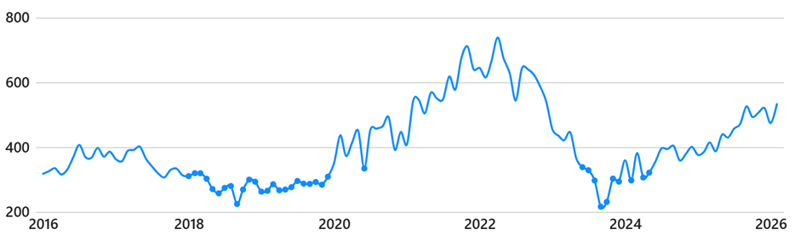
Friday’s AuctionsPlus commercial cattle sales gave us a fair indication. The AuctionsPlus Young Cattle Indicator (AYCI) pushed to levels we haven’t seen since December 2022. It’s not a spike, more a steady upward trajectory, which arguably says more about confidence than a one-week jump ever could.

AuctionsPlus Young Cattle Indicator (c/kg).
After averaging 474c/kg in January, the AYCI lifted to 533c/kg to close February. For perspective, the AYCI peaked back in December 2022 at 541c/kg, while the low in September 2023 sat at 216c/kg. We’re a long way from both extremes, but the direction it's travelling is worth noting.

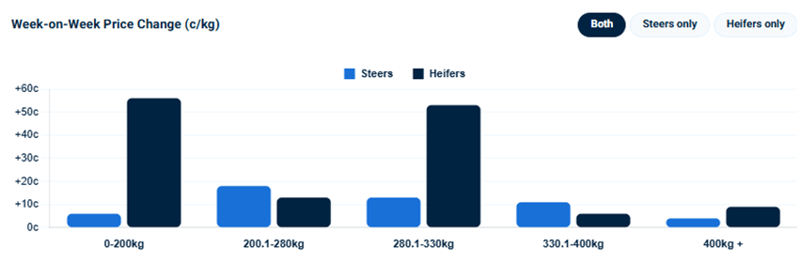
Heifers in particular found another gear in last Friday’s commercial cattle sales on AuctionsPlus. In the 0–200kg category, steers lifted 6c/kg while heifers jumped 56c. In the 280–330kg range, heifers lifted 53c compared to a 13c rise for steers. Steers held slight premiums in the 200–280kg and 330–400kg categories, and at the heavier-end heifers lifted 9c to steers’ 4c.

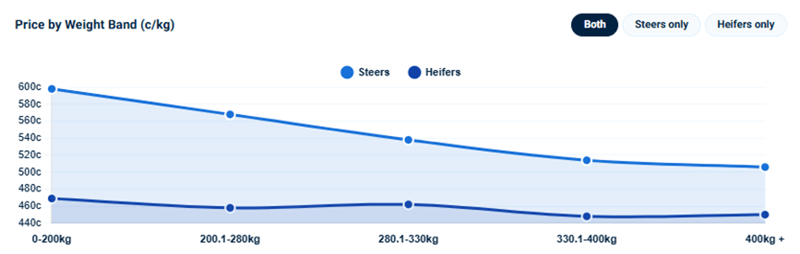
Lighter steers continue to command a clear premium on a cents-per-kilo basis, peaking at 598c/kg in the 0–200kg category and sitting around 506c/kg in the 400kg-plus category in last week's commercial sales. Heifer pricing showed less variation, topping around 469c/kg and dipping to roughly 448c/kg through the mid-weight ranges.
Clearance rates were also telling. Steers cleared at around 80% and heifers at 78%, which suggests buyers were broadly prepared to engage across categories.
When the heifer market heats up, people get excited about rebuilding activity, but I'm not sure that's the case here. There's the intersection of lower offerings, higher prices in steers driving activity to the heifer market, and perhaps even some people hedging their bets on growing out heifers to either breed from or sell on depending which way the season unfolds.
Which brings us back to the weather. I'm not going to list the total across south eastern Australia here because they are still rising. Overall there's a lot to be happy with, with good soaking rain making an impact across a lot of drought areas. There is of course areas where too much has fallen too quickly, but overall it's been a positive boost to sentiment.
The lift in pricing and solid clearance in AuctionsPlus' commercial cattle sales on Friday came between the first falls and this further follow up rain. That’s unlikely to be coincidence. Even modest falls can shift sentiment quickly, particularly when nerves have been building. But one rain event doesn’t make a season, and much will hinge on whether follow-up systems arrive before we move further into autumn.
The Bureau of Meteorology's (BOM) latest long-range outlook says for March, rainfall is likely to be above average across much of the north, which fits with the heightened tropical activity we’ve seen during this wet season. Across much of the south there’s no strong signal either way, meaning roughly equal chances of above or below average rainfall. Looking across autumn more broadly, the Bureau is leaning toward below average rainfall for most southern areas and above average rainfall for parts of the north, along with warmer than usual days and nights across most of the country. Increased fire risk has also been flagged for parts of NSW, Victoria, South Australia and Western Australia.
So is this rain a very early break, a false start, or just the start of a great season to come?
There’s also the wider backdrop to consider with uncertainty in the Middle East that is likely to influence global fuel and fertiliser markets, an EU trade deal on the cusp of being announced and continued global trade wars.
With some rain under the belt and a less-than-inspiring outlook ahead, is this the moment to lock in a margin or stay the course and back the season in? Prices are on a rising plane and confidence has improved, but we’re not in boom territory.
Like most things in this game, it comes back to individual position and appetite for risk. Feed on hand, water security, cost base and market access all matter more than any headline. The season will declare itself soon enough. In the meantime, the market and weather is giving a little more optimism than it was a few weeks ago and we've got to be happy with that.
There’s plenty happening in cattle markets at the moment, and as always, weather is sitting front and centre.
Australia's grain fed beef sector continued to break records in the December quarter - with capacity, utilisation and numbers on feed exceeding...
The Australian Bureau of Statistics (ABS) released it’s quarterly ‘Livestock Products’ data and statistics on Friday. There is plenty of data to dig...