
 Ripley Atkinson
Northern rain and the cost of freight
 Andrew Woods: Oct 14, 2026
The forecast is looking promising for vast parts of Queensland and Northern NSW for the coming week.If you are looking for rain, of course.Rain will...
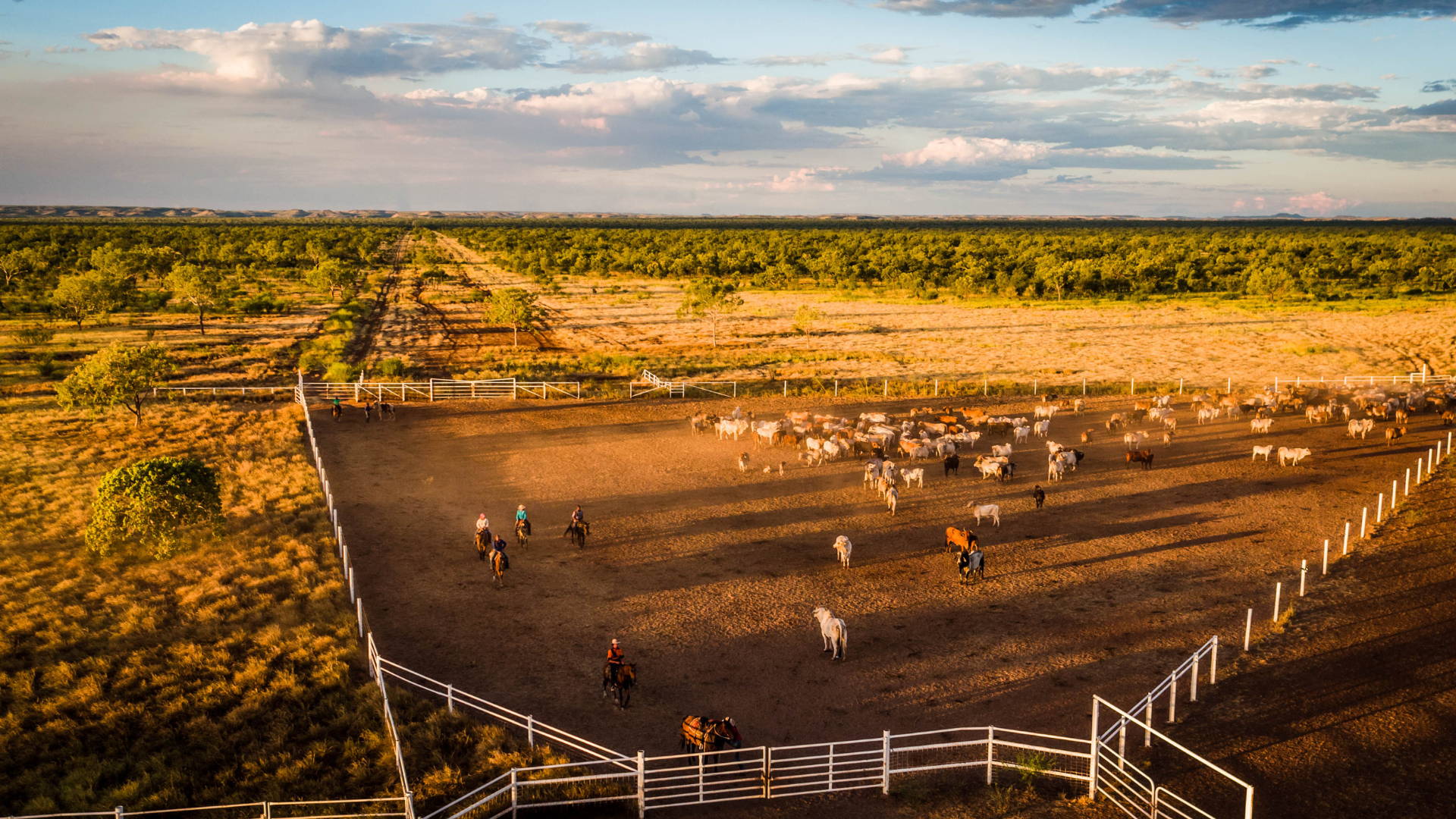
Much has been discussed in industry circles and events in recent months, around the big question of whether the herd will rebuild in 2026.
I have written on this subject via APlus News for the best part of 12 months, with my most recent column, identifying that the herd would liquidate in 2026, coming in the H1 2026 StoneX Australian cattle market outlook published in February.
There are several factors which point towards the liquidation, namely northern NSW cattle yardings, which accounted for over 30% of the national total for the month of March, plus multiple records broken across key selling centres within these regions. In March for northern NSW, over 125,000 head were sold through these saleyards, the highest figure on record.
On top of this, NLRS has recorded multi-year highs in weekly slaughter numbers nationally as cattle move far and wide to be processed,
A lack of intention to rebuild numbers – across several key categories and locations is an additional factor, this article identifies those themes:
Sustained herd liquidation in the key cattle region of northern NSW / southern QLD
Buyers on AuctionsPlus preferencing steers to trade over heifers to rebuild
The current cattle cycle – above average herd size and seasonality
In my last column, the role of Northern NSW supply was discussed against the backdrop of challenging seasonal conditions. This was further supported by an article last week written by Natasha Lobban about listings of cattle on AuctionsPlus, with supply from these regions exceeding drought benchmarks.
Drought through these regions has driven an intense sell-off of stock, via saleyards, online platforms and direct channels. This is creating herd liquidation and ultimately in future a tight contraction in availability of cattle supply.
The seasonal challenges in these regions, coupled with historically strong cattle prices, has encouraged producers to adopt a sell down mindset rather than 2019, where feeding through was preferred.
Data on price spreads from AuctionsPlus, identifying buyer preferences for weaner steers over heifers, further reinforces the notion that herd rebuilding is a long way from eventuating.
The data analysed by StoneX, examines the price spreads between weaner steers and heifers in percentage terms and actual value terms. As Figure 1 below shows, the rebuilding period of 2020-2023 signifies the period where intense demand for future breeding females saw spreads tighten as heifer prices narrowed to near evens with steers.
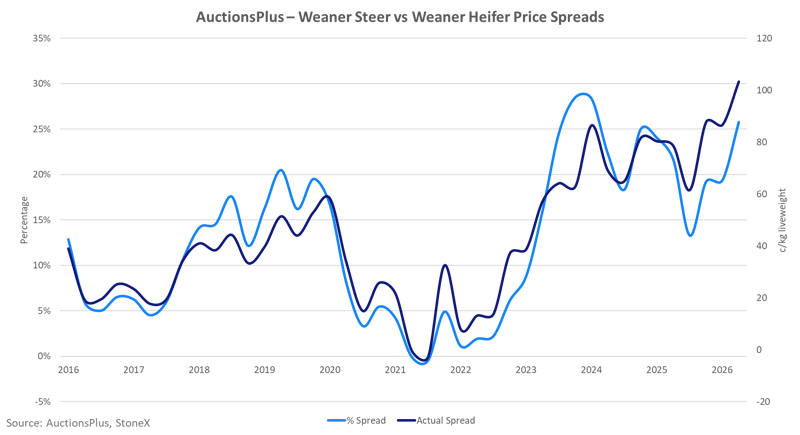
Compare that relationship to today, and on actual values, steer premiums over heifers is at its widest level since AuctionsPlus data recording began in 2016, which includes two herd cycles, the lows and highs.
So far with one third of Quarter 2 2026 complete, actual spreads for steers over heifers is averaging A$1.03/kg liveweight, and percentage spreads is sitting at 26%, the third highest quarter on record.
This data demonstrates that buyers are preferencing steers and as such, demand for steers is increasing price premiums over heifers. This data solidifies anecdotal evidence, that buyers, particularly in the south, are chasing steers for a short-term trade to drive cash flows to rebuild balance sheets post drought.
Producers are not looking for long-term investments in females to rebuild the herd. If they were, the premiums for steers over heifers would be narrowing on a trajectory towards the 2020-22 levels, we’re a long way from that.
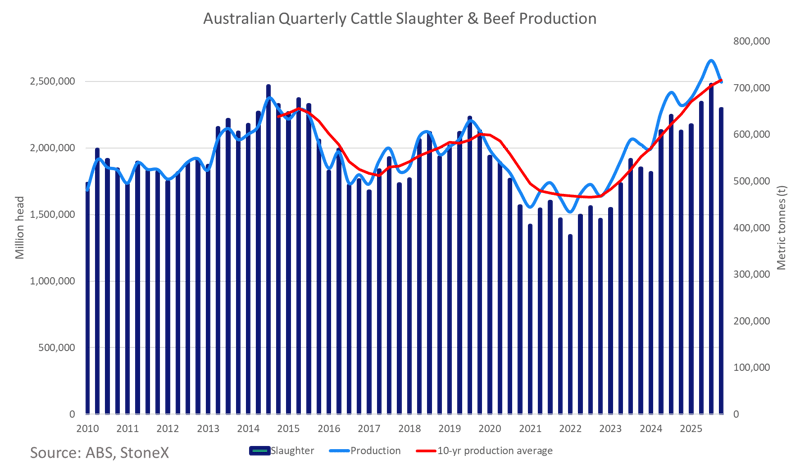
Where the current cattle cycle is positioned indicates that the rebuild may still be at least 12 months from commencing. By that, I mean, we are seeing record slaughter volumes, record beef production and record exports, and have done for the past 12 months.
Figure 2 below, which shows quarterly slaughter and production volumes, suggests that in 2026 we’re likely to see the peak of the cycle. This data, combined with the cyclical nature of the herd, indicates that we’re likely to see declining slaughter and production numbers late in 2026 and into 2027, whereby the herd rebuild, dependent on seasonal conditions improving for key regions to support rebuild intentions may eventuate.
It's likely, that northern NSW will rebuild faster than the south, because producers have sold down sooner and not fed cattle through, meaning balance sheets and financials should be in a healthier position than at the end of the 2019 drought, allowing a more confident step into breeding females. But currently, the key region of central eastern Australia is experiencing drought, and subsequently a large number of breeding females have been killed – which is further evidence of the possibility of liquidation continuing, not rebuild.
Understanding market fundamentals and the cycle of the herd ensures producers remain in touch with key drivers and themes which can influence pricing performance.
Drivers outside of the herd cycle are currently influencing market pricing, namely underlying fundamentals of solid domestic buying demand from feedlots and processors, supported by the global protein deficit which is aiding Australia’s position from a global perspective for beef demand.
Drivers of herd rebuilding are not influencing market pricing at present because it isn’t happening and as such are unlikely to drive price performance in the medium term until it does.

Ripley Atkinson's experience in the red meat industry and current role at StoneX developing price risk management tools for Australia’s sheep and cattle sectors ensures he delivers unique, whole of supply chain insights and analysis across key factors such as prices, supply, production and the drivers of the sheep and cattle cycles.
StoneX Disclaimer The StoneX Group Inc. group of companies provides financial services worldwide through its subsidiaries, including physical commodities, securities, exchange-traded and over-the-counter derivatives, risk management, global payments and foreign exchange products in accordance with applicable law in the jurisdictions where services are provided. References to over-the-counter (“OTC”) products or swaps are made on behalf of StoneX Markets LLC (“SXM”), a member of the National Futures Association (“NFA”) and provisionally registered with the U.S. Commodity Futures Trading Commission (“CFTC”) as a swap dealer. SXM’s products are designed only for individuals or firms who qualify under CFTC rules as an ‘Eligible Contract Participant’ (“ECP”) and who have been accepted as customers of SXM. StoneX Financial Inc. (“SFI”) is a member of FINRA/NFA/SIPC and registered with the MSRB. SFI is registered with the U.S. Securities and Exchange Commission (“SEC”) as a Broker-Dealer and with the CFTC as a Futures Commission Merchant and Commodity Trading Adviser. References to securities trading are made on behalf of the BD Division of SFI and are intended only for an audience of institutional clients as defined by FINRA Rule 4512(c). References to exchange-traded futures and options are made on behalf of the FCM Division of SFI . StoneX is a trading name of StoneX Financial Ltd (“SFL”). SFL is registered in England and Wales, Company No. 5616586. SFL is authorized and regulated by the Financial Conduct Authority [FRN 446717] to provide to professional and eligible customers including: arrangement, execution and, where required, clearing derivative transactions in exchange traded futures and options. SFL is also authorised to engage in the arrangement and execution of transactions in certain OTC products, certain securities trading, precious metals trading and payment services to eligible customers. SFL is authorised & regulated by the Financial Conduct Authority under the Payment Services Regulations 2017 for the provision of payment services. SFL is a category 1 ring-dealing member of the London Metal Exchange. In addition SFL also engages in other physically delivered commodities business and other general business activities which are unregulated and not required to be authorised by the Financial Conduct Authority. StoneX Group Inc. acts as agent for SFL in New York with respect to its payments services business. StoneX APAC Pte. Ltd. acts as agent for SFL in Singapore with respect to its payments services business. StoneX Financial Pty Ltd (ACN 141 774 727) holds an Australian Financial Service License (AFSL: 345646) for Dealing in Securities, Exchange-Traded Derivatives Contracts, OTC Derivatives Contracts and Foreign Exchange Contracts, and is regulated by the Australian Securities and Investments Commission. ‘StoneX’ is the trade name used by StoneX Group Inc. and all its associated entities and subsidiaries. Trading swaps and over-the-counter derivatives, exchange-traded derivatives and options and securities involves substantial risk and is not suitable for all investors. Past performance of any futures or option is not indicative of future success. Indicators are not a trading system and are not published as a specific trade recommendation. The information herein is not a recommendation to trade nor investment research or an offer to buy or sell any derivative or security. It does not take into account your particular investment objectives, financial situation or needs and does not create a binding obligation on any of the StoneX group of companies to enter into any transaction with you. You are advised to perform an independent investigation of any transaction to determine whether any transaction is suitable for you. No part of this material may be copied, photocopied or duplicated in any form by any means or redistributed without the prior written consent of StoneX Group Inc.
 Andrew Woods: Oct 14, 2026
The forecast is looking promising for vast parts of Queensland and Northern NSW for the coming week.If you are looking for rain, of course.Rain will...
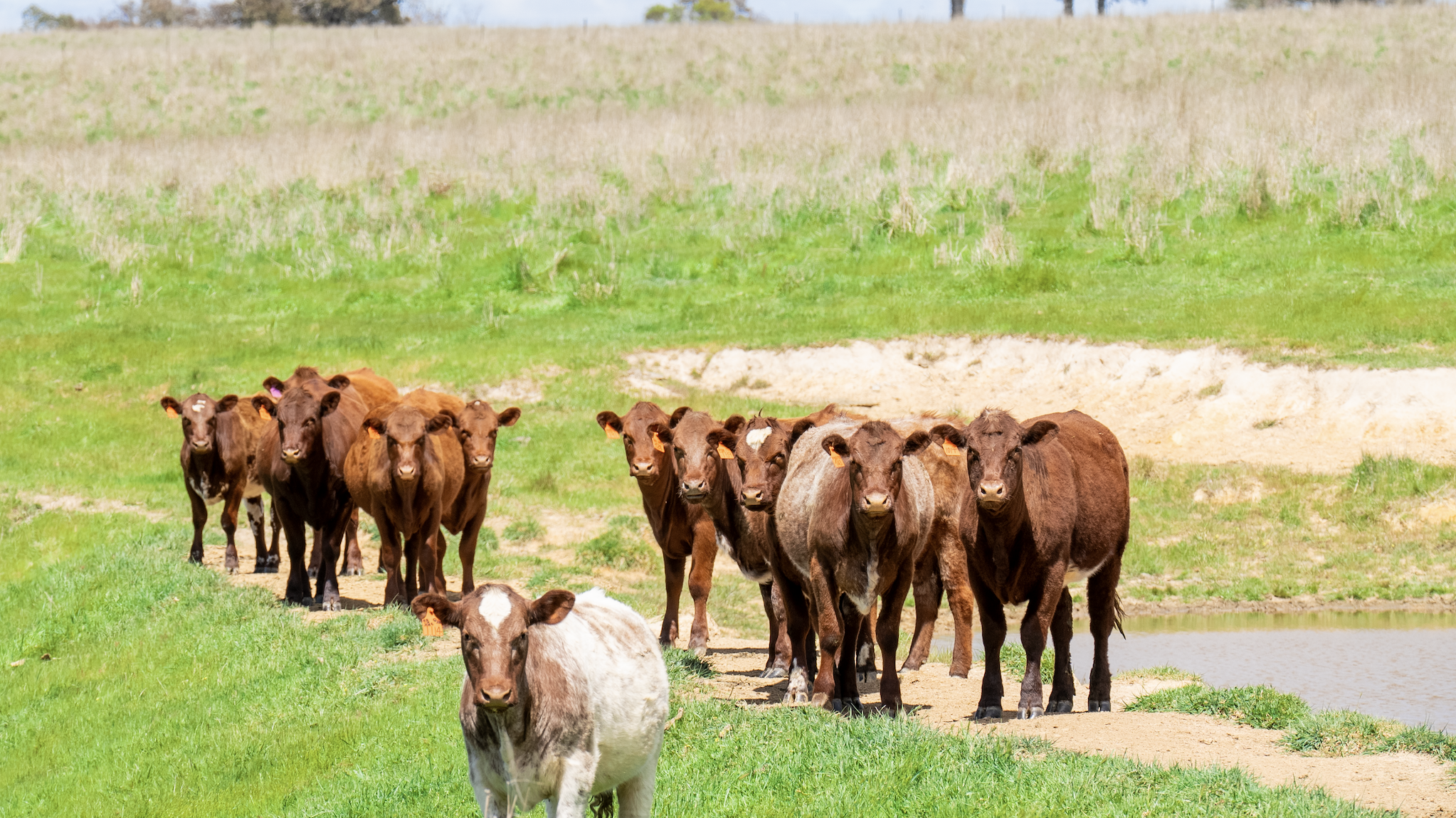
Grass is setting the pace in the cattle market, with restockers outbidding feedlots and processors on AuctionsPlus last week.
 Natasha Lobban: Oct 8, 2026
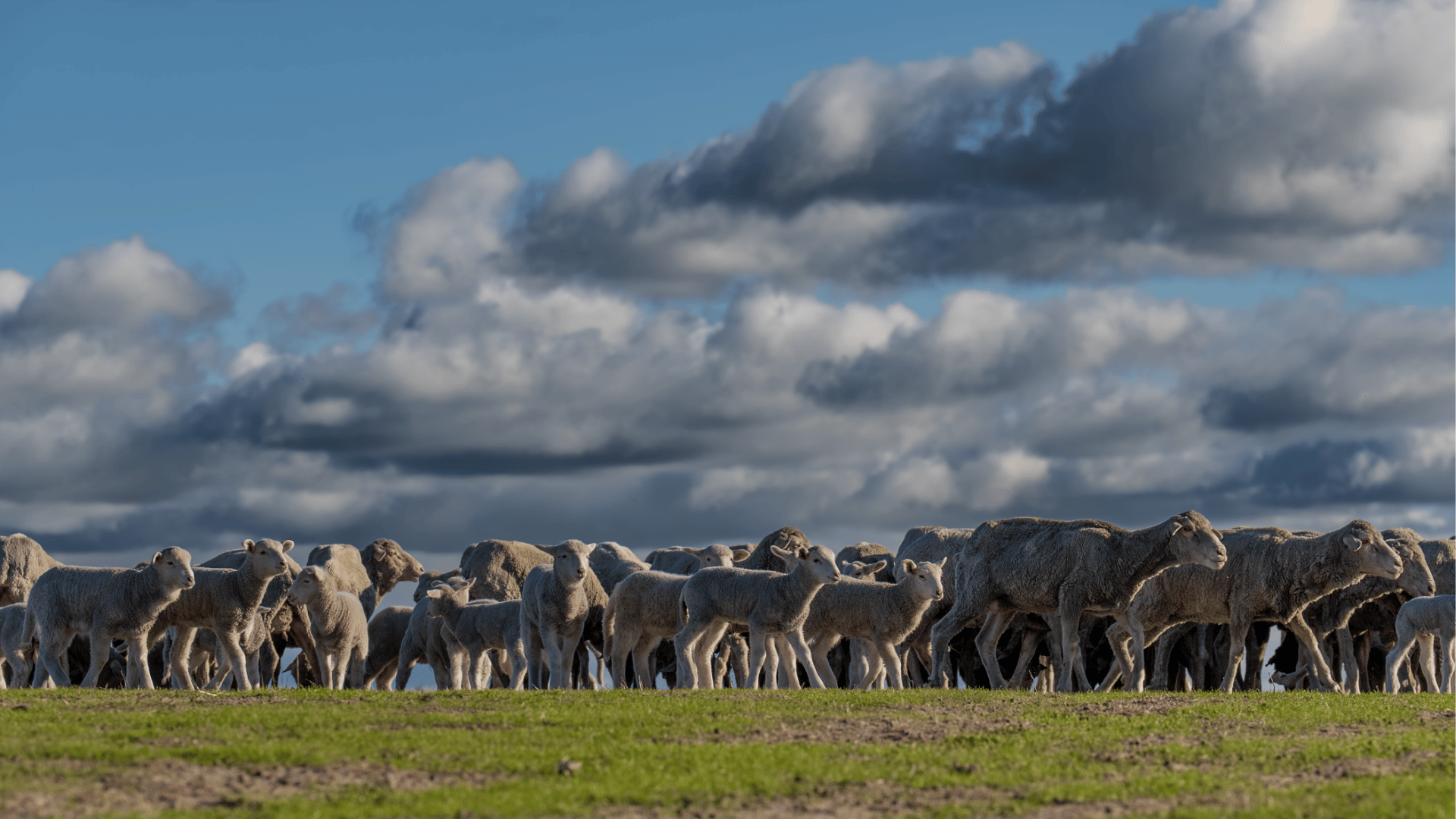
AuctionsPlus has recorded its biggest September for new season lambs in the past decade, with 218,871 head offered across the month.