
Northern NSW drives record listings as southern demand absorbs supply
There has been a sustained and rapid lift in Northern NSW commercial cattle supply offered on AuctionsPlus in early 2026, with April volumes reaching...
5 min read
Natasha Lobban
:
Apr 28, 2026
There has been a sustained and rapid lift in Northern NSW commercial cattle supply offered on AuctionsPlus in early 2026, with April volumes reaching their highest monthly level on record.
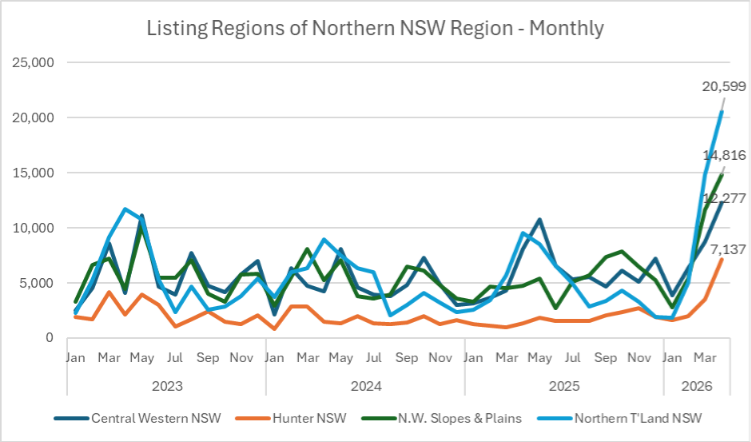
The Northern Tablelands alone offloaded more than 20,000 head on AuctionsPlus for the month, following a similarly strong March result, confirming the seasonally driven sell-off activity.
On the ground, producers are reporting that this dry period has hit both quicker and harder than previous drought cycles. With forecasts pointing toward further widespread El Niño-driven deterioration, the out-flow of stock from the region is pointing to a clear reluctance to carry stock through tightening conditions.
That shift may also be being influenced by the higher capital value of cattle. With dollars per head significantly elevated compared to past drought cycles, the financial stakes are greater. Producers are increasingly focused on risk management, opting to preserve equity rather than commit to feeding through uncertain seasonal conditions.
This behaviour is translating into a supply surge that is now exceeding previous drought benchmarks.
Listings out of Northern NSW have climbed to above 40% of the total AuctionsPlus commercial cattle offerings, with April tracking at 55%. This surpasses the 2019 drought peak, where listings reached just under 50%, and sits well above the long-term average of 36%.
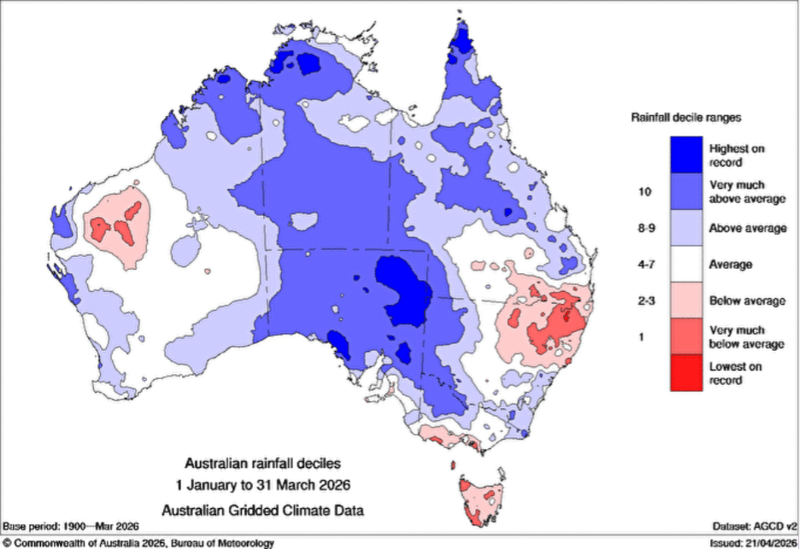
A key difference this time is geographic concentration. Current dry conditions are largely confined to Northern NSW and southern Queensland, rather than being widespread nationally, as shown in the BOM graphic above, which bodes well for national market confidence, as opposed to longer-term and widespread drought-induced liquidations.
As shown above volumes across the Northern Tablelands and NW Slopes & Plains have lifted sharply through 2026, reinforcing the scale and persistence of the current supply event.
The uplift in listings is translating directly into record throughput throughout Northern NSW.
Northern Tablelands recorded more than 20,000 head in April, the highest monthly volume on record since 2016 and March 2026 followed with 14,841 head, which is the second highest. We have to go back to March 2016 for the third highest at 13,000 head. Year-to-date (Jan–Apr) listings have reached 42,283 head, up 43% on the previous high (2022).
While all categories of stock have increased, the composition of supply is evolving and this is where longer-term implications begin to emerge.
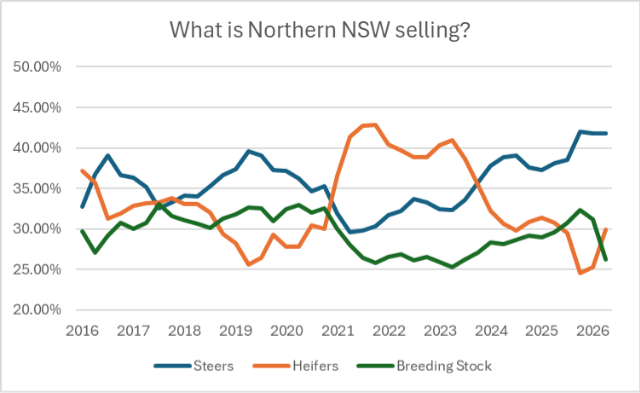
The initial phase of the sell-off, through late 2025, was dominated by breeding stock rationalisation. Strong cull cow prices made it a relatively straightforward decision for producers to reduce older cows first, followed by steers as seasonal pressure intensified.
What has changed in 2026 is the increasing presence of heifers coming onto the market.
Significant volumes are being sold in in the 200–280kg weight category, including 4,393 steers and 7,280 heifers in April; and Steers have lifted to account for more than 40% of the total offering.
However, the emergence of heifers in larger numbers signals a deeper level of herd adjustment. Unlike earlier phases of the cycle, where producers could trim less productive animals, the decision to sell heifers has potential longer-term implications for breeder numbers and herd rebuilding capacity.
This is occurring at a time when pricing signals are also diverging. Heifer values remain relatively subdued, while the AuctionsPlus weaner steer premium has lifted to its highest level in more than a decade (more to come on that next week). That widening spread is further influencing decision-making.
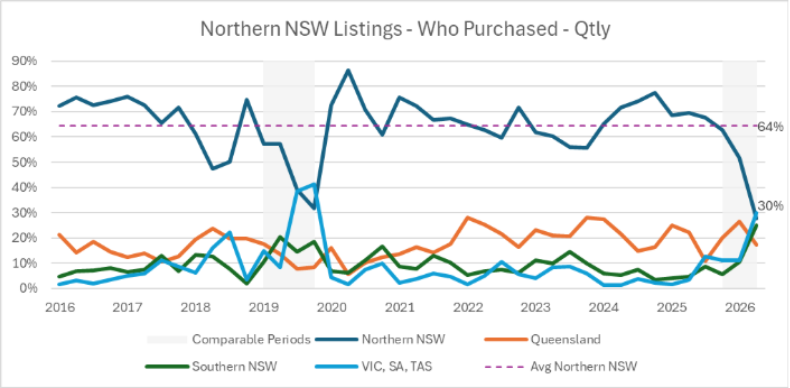
Northern NSW buying activity is also a record lows, with local participation falling to 18.1% last week. The four-week average sits at 31.5%, well below the long-term average of 65%.
The supply in Northern NSW is rising rapidly, while local producers, facing the same seasonal constraints, are largely absent from the buying side.
The gap is being filled by strong interstate demand, particularly from southern regions benefiting from better seasonal conditions.
VIC/SA/TAS accounted for 46.4% of AuctionsPlus purchases from Northern NSW last week. Their four-week average sits at 28.2%, well above historical levels (10%). Southern NSW purchased 18.4% from Northern NSW last week, although buying momentum appears to be easing from this area.
The graph above highlights this shift, with southern regions materially increasing their share of purchases as northern participation declines.
Several southern regions have emerged as key demand centres:
This level of activity confirms that southern systems are actively restocking and absorbing northern supply where seasonal conditions allow.
When analysing the lift in numbers coming onto AuctionsPlus, it would be remiss not to consider why producers are choosing this channel over others as a key part of the picture.
With supply concentrated in Northern NSW and demand sitting further south, producers are increasingly looking beyond local markets to find competition. AuctionsPlus is playing a key role in this shift, providing a trusted and transparent channel to connect buyers and sellers across regions.
This is not the first time this dynamic has emerged. During the 2018–19 drought cycle, AuctionsPlus listings grew by 28% year-on-year, broadly in line with saleyard growth of 25%. In contrast, in 2026 AuctionsPlus listings have increased by 91% year-on-year, outpacing saleyard yarding growth of 68%. This divergence suggests the platform is becoming more embedded in the national supply chain, particularly reflecting its ability to connect buyers and sellers across regions operating under different seasonal conditions.
From a vendor perspective, there is a clear risk management benefit. In a physical sale environment, producers are largely committed on the day or face the cost of transporting stock home. Online, there is greater flexibility to reoffer or hold if competition isn’t there, this is particularly relevant when local buying capacity is constrained. The absence of upfront freight costs is also a factor that has also been enticing vendors online, with elevated diesel prices due to the Middle East conflict adding further pressure to transport economics.
For buyers, particularly those purchasing out of region, online sales are supporting confidence. Standardised assessments and upfront cost visibility allow for more informed decision-making. In a season where cattle condition can vary, that transparency is critical. A more distributed selling model also allows freight to be planned and managed more efficiently, giving buyers certainty around delivery timing and cost.
Taken together, the increase in volumes on AuctionsPlus reflects more than just seasonal conditions. It highlights how the market is adapting, using a trusted, transparent channel to move cattle from areas of excess supply to areas with demand and feed, in a more controlled and commercially manageable way.
Northern NSW purchased just 18.1% of its local offering last week. The four-week average sits at 31.5%, well below the long-term average of 65%.
Several southern regions have emerged as key demand centres, such as South West Victoria which purchased 2,354 head in April, exceeding its total annual purchases in recent years.
Natasha Lobban is the Content Manager at AuctionsPlus, bringing more than 20 years of experience in agricultural media and communications. Based on a farm in North East Victoria, she combines deep industry knowledge with a passion for keeping producers informed and telling the stories of the people behind Australian agriculture.
There has been a sustained and rapid lift in Northern NSW commercial cattle supply offered on AuctionsPlus in early 2026, with April volumes reaching...
Two distinct dynamics are emerging across both cattle and sheep markets, each with important implications for pricing signals and producer...
In the past month we’ve seen cattle prices across all categories in both direct consignment and auction systems ease by 8-15%, depending on where...