


5 min read

QLD Processors at Capacity as Production continues to lift: ABS Report Card

QLD Processors at Capacity as Production continues to lift: ABS Report Card
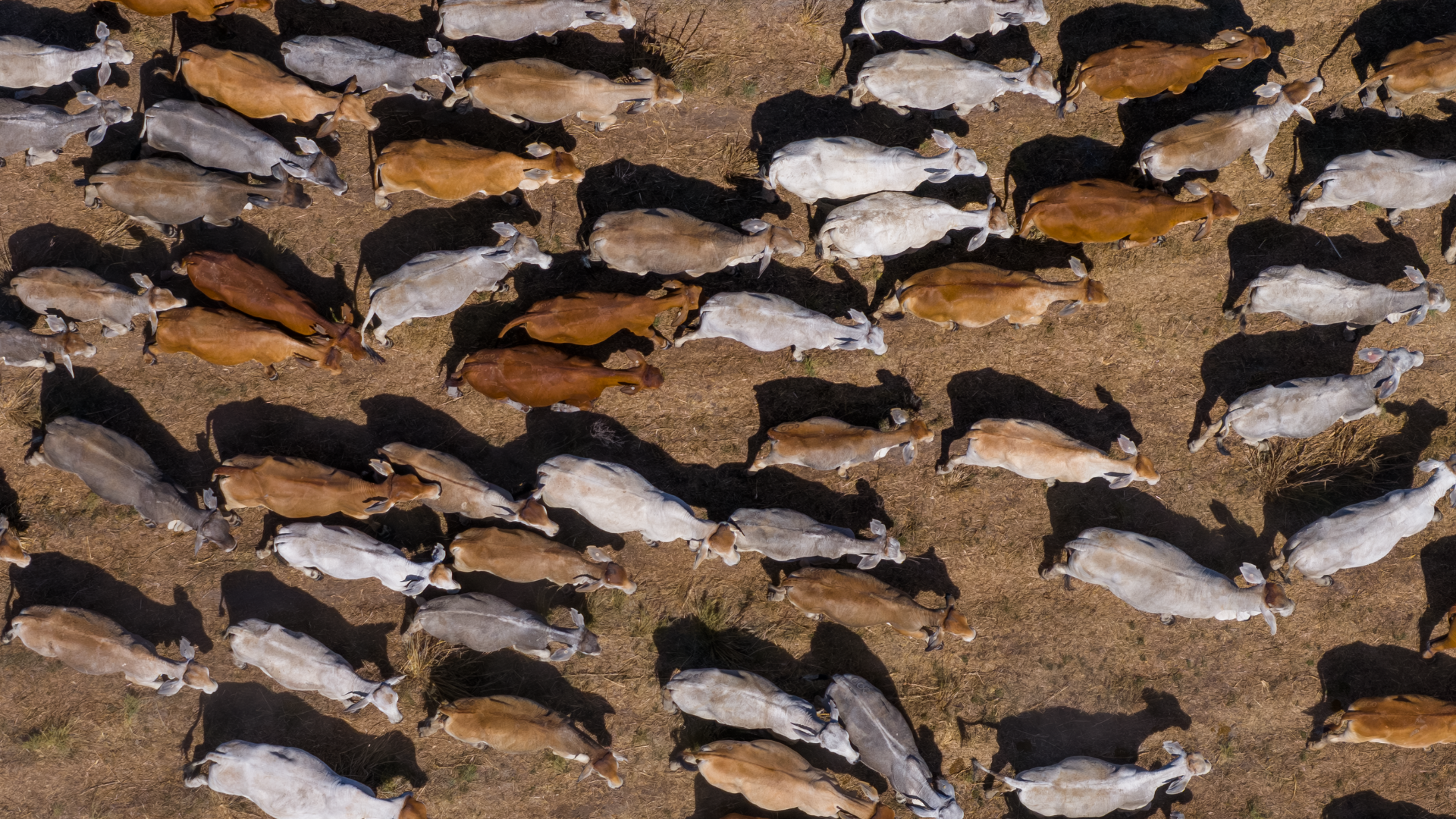
Pic: AgriShots
QLD Processors at Capacity as Production continues to lift: ABS Report Card
10:21


Yesterday, the Australian Bureau of Statistics (ABS) released the Quarter 3 2026 Slaughter & Production numbers for the red meat industry.

This data now provides detailed insight into how the Year to 30 September has performed and the quarter itself.

Headline Numbers

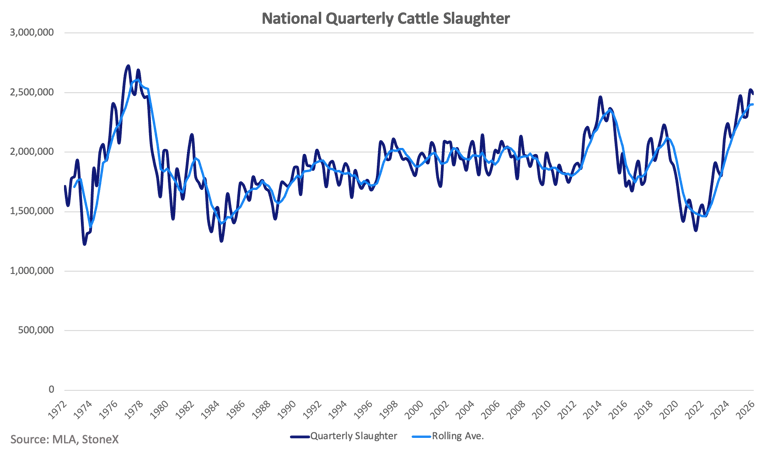
  1. Quarter 3 Adult cattle slaughter reached 2.49 million head – the second highest quarterly volume since 1978 (only behind Q2 2026)
  2. The reporting differential between MLA’s NLRS & ABS figures blew out 6% in Q3, with the differential of 31% the highest level since COVID – driven by the cessation of a QLD processor reporting to MLA.
  3. Beef production – underpinned by gradually rising carcase weights, is now 6% or 130,000 mt in front of Year-to-Date 2025 volumes.

Slaughter

Despite recently seeing in NLRS reporting, weekly processing numbers continue to slide, the Quarter 3 results surprised to the upside, outperforming expectations.

As per Figure 1 below, at 2.49 million head, that figure was the 2nd highest since 1978 at a national level, and Year-on-Year (YoY) was slightly higher than the 2.475 million head processed in Q3 2025. When averaged across the quarter, the weekly kill was 191,000 head, flat on Q2 2026.


Figure 1.

In Year to Date (Q3 2026) terms, cattle slaughter of 7.314 million head is 4.7% or 327,000 head higher than the corresponding period in 2025. Now there’s no doubt that volumes have continued to decline since peaking in Quarter 2, but the results continue to reflect the large pipeline of cattle supply that the processing sector is handling.


Processor Capacity

From a capacity perspective, which measures the quarterly kill level, relative to the past 10-years of quarterly data as a percentage, the two key states of NSW & VIC saw retractions in throughput whilst QLD continued to lift its kill.

In QLD, Q3 slaughter hit its highest level in 11 years, or since Q3 2015– and that placed the major processing states capacity, at 100% (when measured against 10-years of data).

Whilst in NSW & VIC, throughput declined, meaning these states operated at 90% capacity. I hold the view that due to the liquidation seen in these areas in 2024-2026 at differing times has limited cattle supply in Q3. I do acknowledge both states plants will have had large numbers of northern cattle, but I suspect the decline can most likely be attributed to a reduction in available supply of local stock.


Production & Carcase Weights

Two forces at play are combining to support a continuous, gradual lift in carcase weights, which coupled with strong slaughter, is delivering these large production numbers we’re seeing. Those factors, are the

  1. The strength of the Northern wet season in 2025/26, supporting grassfed kill cattle turnoff weights, and;
  2. Higher grainfed turnoff and the higher numbers of grainfed cattle as a share of total slaughter in processing plants.

These factors, combined with the heightened levels of cattle slaughter are the fundamental drivers of these high levels of beef production the sector is putting out. To put into context, Q3 beef production was 34% or 199,000 metric tonnes higher than the 10-year quarterly average – demonstrating the growth in production the sector is delivering. Year-to-Date beef production is 2.285 million mt and is ahead of 2025 numbers by 130,000 metric tonnes or 6%.


What does this mean?

The national kill up until the end of Q3, continues to perform admirably, but I suspect that when the Q4 numbers are presented, that we see the sharp pullback in throughput reported. The collision of rain, a rallying market, accessibility issues and a flat to softer export market has meant that processors in the 4th quarter have instead chosen to wind down throughput.

Importantly, NSW & VIC plants have space or spare capacity, why this matters is because if and when QLD & Northern Australia goes dry, that space will be needed to handle the higher supply.

For the broader market, these results can be read as broadly positive, and continue to reflect the large herd size the sector is currently holding. The large production volumes Australia is producing regularly is here to stay, and that’s mainly driven by the expansion in the grainfed kill which is offsetting fluctuations in seasonal conditions.

One can expect beef production to remain elevated and continue to rise over the long term.


Ripley Atkinson's experience in the red meat industry and current role at StoneX developing price risk management tools for Australia’s sheep and cattle sectors ensures he delivers unique, whole of supply chain insights and analysis across key factors such as prices, supply, production and the drivers of the sheep and cattle cycles.

StoneX Disclaimer The StoneX Group Inc. group of companies provides financial services worldwide through its subsidiaries, including physical commodities, securities, exchange-traded and over-the-counter derivatives, risk management, global payments and foreign exchange products in accordance with applicable law in the jurisdictions where services are provided. STONEX is the trade name used by STONEX GROUP INC. and all its associated entities and subsidiaries. References to over-the-counter (“OTC”) products or swaps are made on behalf of StoneX Markets LLC (“SXM”), a member of the National Futures Association (“NFA”) and provisionally registered with the U.S. Commodity Futures Trading Commission (“CFTC”) as a swap dealer. SXM’s products are designed only for individuals or firms who qualify under CFTC rules as an ‘Eligible Contract Participant’ (“ECP”) and who have been accepted as customers of SXM. StoneX Financial Inc. (“SFI”) is a member of FINRA/NFA/SIPC and registered with the MSRB. SFI is registered with the U.S. Securities and Exchange Commission (“SEC”) as a Broker-Dealer and with the CFTC as a Futures Commission Merchant and Commodity Trading Adviser. References to securities trading are made on behalf of the BD Division of SFI and are intended only for an audience of institutional clients as defined by FINRA Rule 4512(c). References to exchange-traded futures and options are made on behalf of the FCM Division of SFI . StoneX is a trading name of StoneX Financial Ltd (“SFL”). SFL is registered in England and Wales, Company No. 5616586. SFL is authorized and regulated by the Financial Conduct Authority [FRN 446717] to provide to professional and eligible customers including: arrangement, execution and, where required, clearing derivative transactions in exchange traded futures and options. SFL is also authorised to engage in the arrangement and execution of transactions in certain OTC products, certain securities trading, precious metals trading and payment services to eligible customers. SFL is authorised & regulated by the Financial Conduct Authority under the Payment Services Regulations 2017 for the provision of payment services. SFL is a category 1 ring-dealing member of the London Metal Exchange. In addition SFL also engages in other physically delivered commodities business and other general business activities which are unregulated and not required to be authorised by the Financial Conduct Authority. StoneX Group Inc. acts as agent for SFL in New York with respect to its payments services business. StoneX APAC Pte. Ltd. acts as agent for SFL in Singapore with respect to its payments services business. StoneX Financial Pty Ltd (ACN 141 774 727) holds an Australian Financial Service License (AFSL: 345646) for Dealing in Securities, Exchange-Traded Derivatives Contracts, OTC Derivatives Contracts and Foreign Exchange Contracts, and is regulated by the Australian Securities and Investments Commission. The views, opinions of the presenters are solely their own and do not in any way reflect the views, opinions, endorsements or recommendations of STONEX. Information and material presented is for educational purposes only and does not constitute any form of investment advice nor an offer or solicitation to invest in any financial instrument. This information provided is prepared by STONEX and is intended for general circulation. It does not take into account the specific investment objectives, financial situation or particular needs of any particular person. You should take into account your specific investment objectives, financial situation or particular needs before making a commitment to invest, including seeking advice from an independent financial adviser regarding the suitability of the investment, under a separate engagement, as you deem fit. Representations of past performance are in no way an indication of future performance and such representations have not been verified by StoneX. No representation or warranty is given as to the accuracy or completeness of the information or material presented. The presentation herein is not directed to, or intended for distribution to or use by, any person or entity who is a citizen or resident of or located in any locality, state, country or other jurisdiction where such distribution, publication, availability or use would be contrary to law or regulation. No responsibility is accepted by StoneX for any loss or damage arising in any way (including due to negligence) from anyone acting or refraining from acting as a result of this information or material. Reproduction or use in any format without authorization is forbidden. © 2026 StoneX Group Inc. All Rights Reserved.

QLD Processors at Capacity as Production continues to lift: ABS Report Card

QLD Processors at Capacity as Production continues to lift: ABS Report Card

Yesterday, the Australian Bureau of Statistics (ABS) released the Quarter 3 2026 Slaughter & Production numbers for the red meat industry. This...

Read More >
How volatile are other livestock prices compared to young cattle?

How volatile are other livestock prices compared to young cattle?

Our recent analysis of Eastern Young Cattle Indicator (EYCI) volatility generated plenty of interest, particularly around whether the larger price...

Read More >
Cattle supply squeeze is on

Cattle supply squeeze is on

There is nothing like some early summer rain in the north to throw normal cattle supply trends into disarray. Cattle slaughter has tanked as rain has...

Read More >