
Cattle prices are expensive, but history says they can go higher
Australian cattle prices have strengthened considerably through the first half of 2026, but looking at nominal prices alone can make today’s market...
With record lamb and mutton prices, very strong wool values and the season to date having been the friendliest in years, sentiment in the sheep industry running strong. Lamb prices have eased in recent weeks, which begs the question, have we seen the peak?
The issue with forecasting lamb, sheep and wool supply, is the lack of solid flock data. The latest release of the ‘Australian Agriculture: Livestock’ report in April promised a 2024-25 sheep flock population in August 2026, so we wait with bated breath for a number which will be a year out of date already.
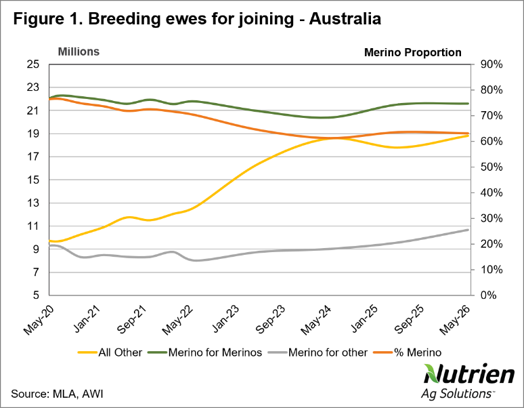
The AWI/MLA Sheep Producers Intentions Survey (SPIS) does provide estimates of breeding ewe flocks each May. The size of the breeding ewe flock is a good base for looking at how many lambs will be produced in the coming year.
Figure 1 shows the SPIS estimates of breeding ewes on hand over the past 6 years. It is noted in the SPIS that the methodology was different prior to October 2022, so comparing current data to pre-2022 values should be done with caution.

The latest SPIS data shows an increase in the number of breeding ewes on hand in 2026, with a rise of 4.5% taking breeding ewes to 51 million head, which is a new high. The increase comes from recovery in the ‘other’ breeds, mostly meat sheep, which move to 18.8 million head.
Merinos for merino rams were steady on last year, while merinos for other rams, increased by 1.1 million head, or 11.3%. The total number of merinos is 1.1 million head higher, which is interesting given the run of tough seasons in 2024 and 2025, and the fact wool prices didn’t really rally until well after joining decisions were made in 2025. The wool price rally was only about halfway through when joining decisions were made for 2026, which might explain the strong ‘merino for other’ number.

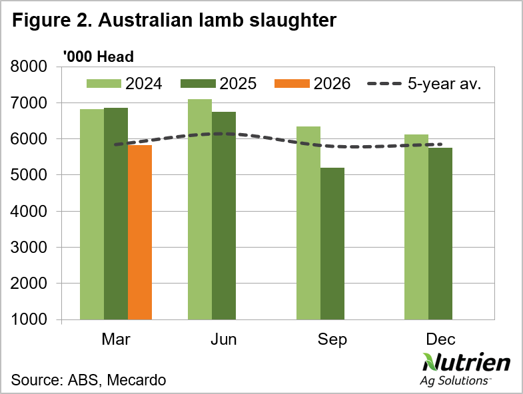
With crossbred ewe numbers back to the 2024 peak, and a strong likelihood of better marking rates, we can expect more lambs this year. Figure 2 shows quarterly lamb slaughter from 2024. The SPIS data suggests that we should have lamb slaughter back at levels seen in 2024-25 at the minimum.
What does this mean?
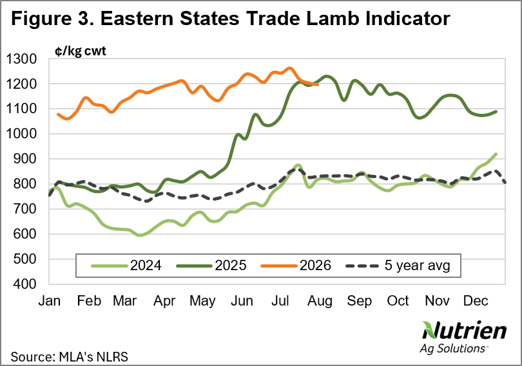
In terms of what this supply scenario means for price, it’s highly likely to be weaker in the 2026-27 season. Demand has in theory improved since 2024, so we’re not going back to 800¢ (Figure 3), but it wouldn’t surprise to see the Eastern States Trade Lamb Indicator (ESTLI) below 1000¢ at stages during 2026-27.

Lamb and mutton prices have spent the winter at record highs.
Survey results suggest breeding ewe numbers are stronger this year.
Despite stronger demand, lamb prices are likely to be lower in 2026-27.
Angus Brown brings over 20 years of expertise analysing Australian agricultural markets, and also runs a mixed farming operation in Hamilton, Victoria.
Australian cattle prices have strengthened considerably through the first half of 2026, but looking at nominal prices alone can make today’s market...
With record lamb and mutton prices, very strong wool values and the season to date having been the friendliest in years, sentiment in the sheep...
Santa Gertrudis cattle out-cleared the wider AuctionsPlus offering in 11 of the past 12 months to June 2026, averaging 89% clearance against 81% for...