
 Michael McManus
Your reserve isn't last week's sold price
 Michael McManus: Nov 4, 2026
If the main goal of listing on AuctionsPlus is to sell cattle for the most money possible, then price setting is one of the most important things to get right. A common way to set a reserve is to look at what similar lines of cattle sold for across the selling channels.
That's a good guide to the market, but not always to a reserve. The strongest results last week were most likely cattle that reached their reserve at auction with several buyers chasing them. The sold price you see is the reserve plus what that competition added. Across AuctionsPlus, cattle sold at auction finished on average about 10% above their reserve.
Set your reserve at last week's sold price and you're asking for that result before the auction has even started. It leaves less room for buyers to compete, so fewer of them bother. Set it below the market and more buyers get involved, which means a better chance there's more than one still bidding when the price reaches market value.
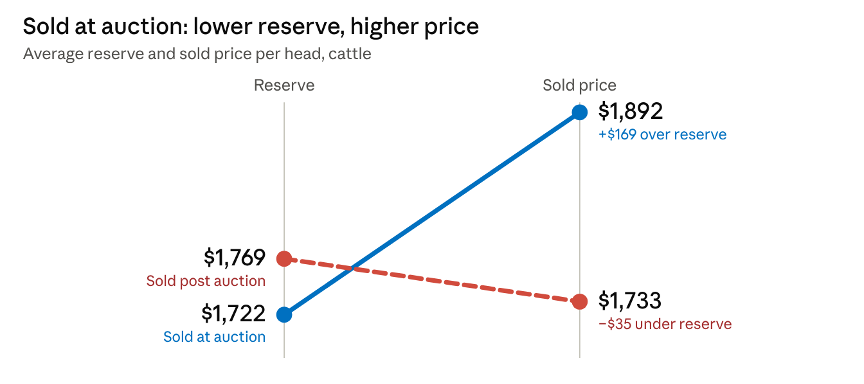
Source: AuctionsPlus · assessed cattle lots FY20–FY27
Cattle that sold at auction started from a lower reserve, yet sold for $159 a head more than cattle sold post auction. Pass in, and the vendor is left negotiating with one buyer. On a 25-head mob, the gap is close to $4,000.
An auction only works when two or more bidders compete. Seven years of AuctionsPlus results show how closely that ties to where the reserve is set.
Across 148,000 cattle lots since FY20, each reserve was compared with the comparable market: what similar cattle, matched on category, breed and week, actually sold for. A reserve counted as “below market” if it sat more than 5% under that price, “at market” if it was within 5% either way, and “5–15% above” or “15% or more above” if it sat higher. Seven lots in ten reserved below the market drew two or more bidders, and 70% of cattle sold at auction. Reserved 15% or more above it, fewer than four lots in ten drew a second bidder, only 27% sold at auction, and more than half went unsold.
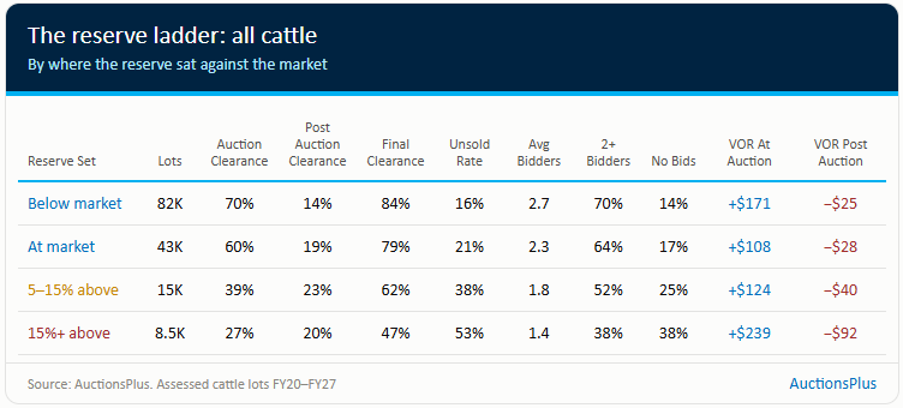
Source: AuctionsPlus, assessed cattle lots FY20–FY27.
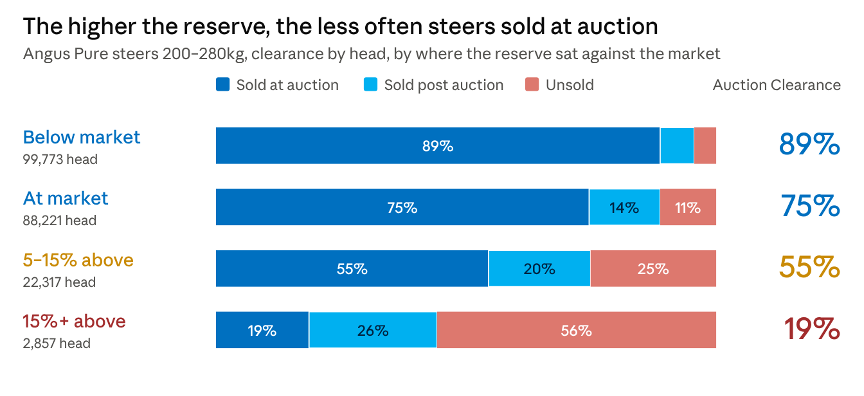
Source: AuctionsPlus · assessed cattle lots FY20–FY27 · Angus Pure steers 200–280kg
Angus Pure steers reserved below the market sat, on average, about 13% under what similar steers sold for. The ones that sold at auction still made $129 a head over their reserve. They drew 3.7 bidders a lot, against 1.7 when reserved 15% or more above the market.
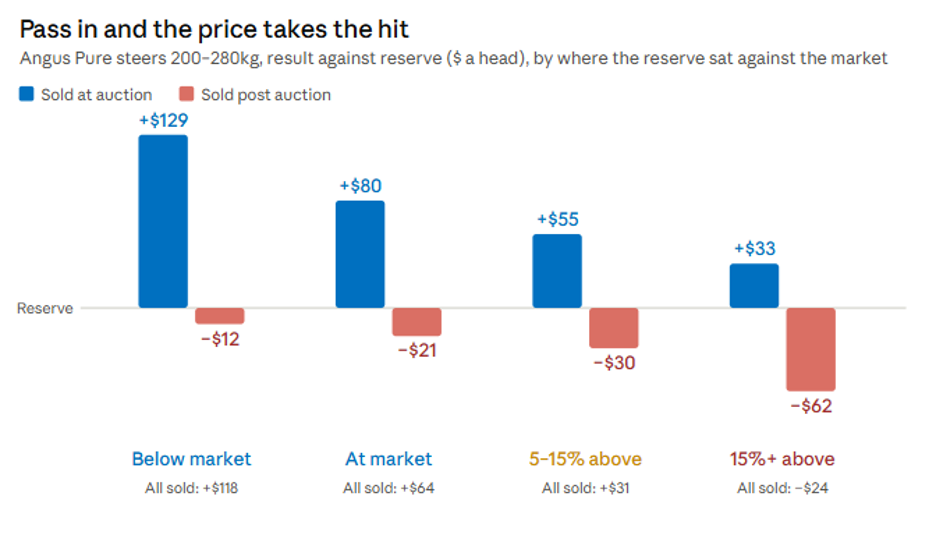
The higher the reserve sat above the market, the less bidding added at auction and the further below reserve a post auction deal landed. Source: AuctionsPlus · assessed cattle lots FY20–FY27 · Angus Pure steers 200–280kg
A high reserve isn't wrong in itself. Some cattle are worth more than the market average, and when an over-market reserve draws competition, the result can be excellent. But it's a bet: reserved 15% or more above the market, more than half the cattle went unsold.
The start price matters too. For cattle reserved at the market, auction clearance was 67% when the start sat close to the reserve and 26% when it was 15–30% below. A low start didn't translate into more cattle reaching their reserve.
So swap "what did they sell for last week?" for a better question: "What's the lowest price I'd accept to see these cattle sold?" Set the reserve there and give buyers every reason to compete.
AuctionsPlus gives you the data to do it:
Find Price Discovery and this week's Market Comments on AuctionsPlus.
Since disruptions to the Strait of Hormuz began in late February 2026, global diesel prices have been highly volatile, increasing costs for...

 Ripley Atkinson