
Chinese deadline pushes exports higher as EU FTA disappoints
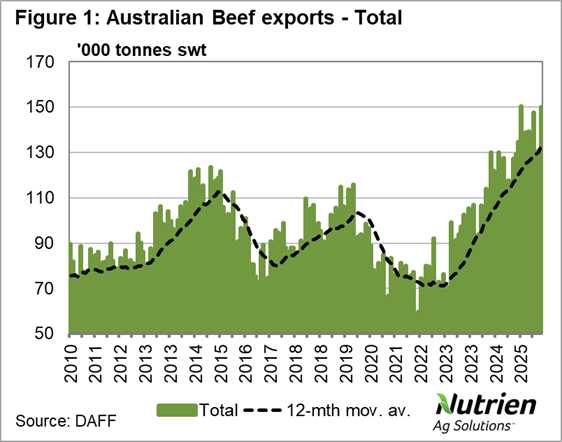
Australian beef exports have steamed through March coming in just shy of 150,000, making it the second-highest monthly export volume on record.
2 min read
Jamie-Lee Oldfield
:
Apr 14, 2026
Australian beef exports have steamed through March coming in just shy of 150,000, making it the second-highest monthly export volume on record.
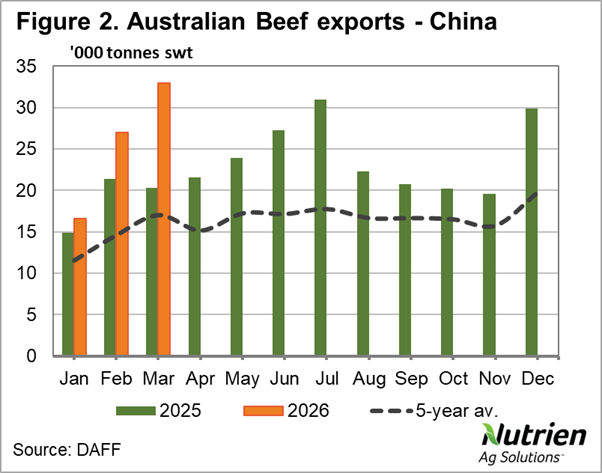
Consistently strong supply from Australia this year has supported the export trade, as has demand out of the US, which took more than 40,000 tonnes for the first month so far this year, and China, whose year-to-date volumes of imported Australian beef are up 35% compared to 2025. But it wasn’t all positivity in beef exports last month, with the provisions agreed upon in the finalised A-EU FTA leaving plenty to be desired for the industry.

Total Australian beef exports rose 33% year-on-year in March, putting the month 58% above the five-year-average, and just 462 tonnes behind the record monthly export figures set in July 2025. Volumes to the top four trade partners all increased, with demand from the US rising 5% from the previous month and putting year-to-date totals to the country 13% higher than the same period last year. Chinese trade was also on the rise as exporters compete to get beef into that market before the new safeguard quota is full. Only two months previously - both at the end of 2019 - have seen more Australian beef head to China, with exports up 62% year-on-year for March.

The tariff which will be applied to Australian beef destined for China once the 205,000 tonne quota is full, along with increasing global trade and political volatility, may have been some of the catalyst for the Australian government to finalise the long-negotiated free trade agreement with the European Union last month. But instead of significantly increasing market access for Australian beef, the outcome has resulted in what Meat & Livestock Australia has labelled “worst ever free trade agreement for Australian red meat industry to date”.
Currently - and likely to be the case for at least the next 1-2 years until the A-EU FTA is ratified by the EU - Australia can export 4400 tonnes carcase weight of beef to the EU which incurs a 20% in-quota tariff, as well as being able to access a global tariff-free high-quality grain fed beef volume of 5851 tonnes, but which can also be utilised by Canada, New Zealand, Uruguay and Argentina. In 2025, Australia exported 7638 tonnes of Beef to the EU, which made up 0.37% of Australia’s total annual beef exports.
Once ratified, the new FTA will after 10 years allow Australia to access a total beef market of 30,600 tonnes, made up of 16,830 tonnes of grassfed and short grain-fed beef tariff-free, and 13,770 tonnes of long grain-fed beef with a 7.5% tariff. For the first five-years of the FTA, however, the accessible volume will be one-third of the eventual total, or just over 10,000 tonnes. Comparatively, the UK has tariff and quota-free access to the EU beef trade, while the Mercosur (Argentina, Brazil, Paraguay and Uruguay) signed a deal in 2024 with will grant them a quota of 99,000 tonnes over five years at 7.5% tariff, and Canada has access to 50,000 tonnes.
Beef exports keeping up with historically high cattle slaughter, the likes of which we haven't seen since the drought-induced turn-off of 2019, should retain positivity in the cattle industry despite the current price dip. While trade with China will drop-off once the new quota has been filled (predictions are that will be by the middle of the year) volumes already sent there teamed with increased demand from all our major markets should continue to support trade. Unfortunately, when it comes to the EU, even when the new agreement comes into full effect - which is at least a decade away - that market will still represent very little of the Australian beef trade.
Jamie-Lee Oldfield is a seasoned agri-media, communications professional and livestock market analyst who lives and works on a family-owned stud and commercial beef and sheep operation in Coolac, NSW.
Australian beef exports have steamed through March coming in just shy of 150,000, making it the second-highest monthly export volume on record.
Australia’s feedlot sector experienced a clear recalibration during 2025, driven by shifts in Wagyu production, feeding economics, and market...
Two short weeks didn’t slow the sheep and lamb market, with national indicators in the green right across the board, and restocker lambs now above...