Ovine slaughter down but is it enough?
The Australian Bureau of Statistics (ABS) released it’s quarterly ‘Livestock Products’ data and statistics on Friday. There is plenty of data to dig...
The Australian Bureau of Statistics (ABS) released it’s quarterly ‘Livestock Products’ data and statistics on Friday. There is plenty of data to dig through, but today we look at headline numbers and possible impacts on supply as we move into autumn.
Long time readers will have heard the bemoaning from these pages around how the ABS used to release ‘Livestock Production’ monthly. Monthly data made for timely analysis. With the quarterly data now released six weeks after the end of the quarter, analysis is somewhat less timely, but worth doing anyway.

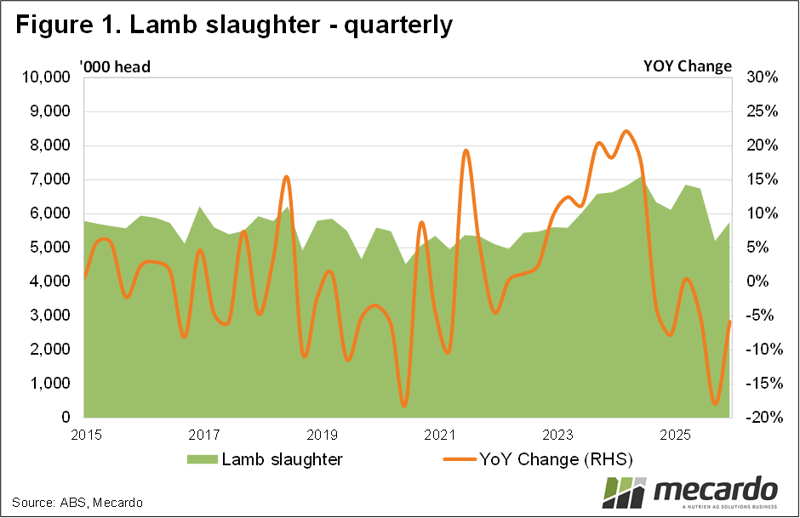
Figure 1 shows National lamb slaughter was up for the quarter but well down year on year. With 5.113 million head of lambs going over the hooks, December quarter lamb slaughter was down 5.8% on 2024 and 15.1% on 2023. Annual lamb slaughter for 2025 finished at 24.56 million head, down 6.9% on 2024.
High Lamb slaughter rates in the first half of 2025 significantly boosted the annual total, which came in 24% higher than the second half. Given the drop in supply, it was little wonder prices rallied so strongly in the second half of the year.
However, December lambs slaughter wasn’t diabolically low. During the flock rebuild of 2020-21 December lambs slaughter averaged 5.2 million head, 10% lower than December 25.

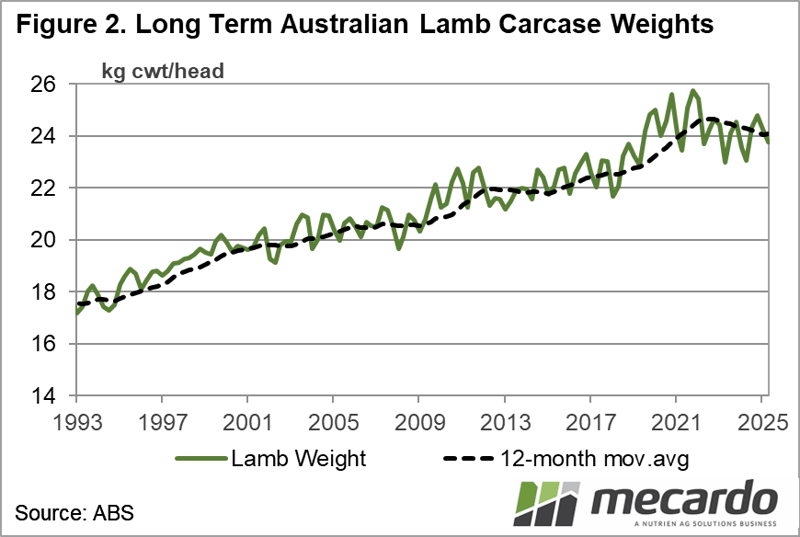
Another pointer towards a shift to flock rebuild is higher carcass weights. Figure 2 shows average carcase weights were 23.8kgs/hd in December, up from 23.1 in December 2024, and the second highest December figure on record. The 12-month rolling average is still in decline however, and we are likely to see this turn during 2026.

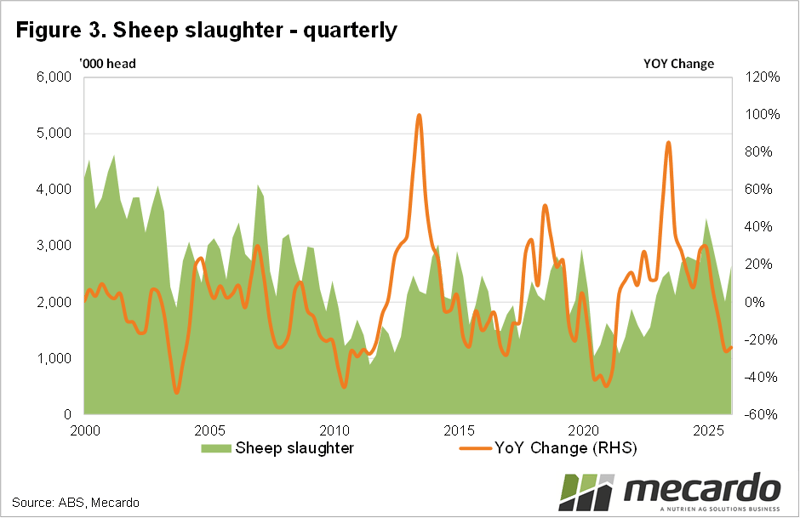
Sheep slaughter for December, at 2.65 million head, was down 24% on December 2024, with annual slaughter down 13.5%. The numbers are a little skewed, with December 2024 having been the largest quarterly slaughter since 2006, and total 2024 slaughter also being the highest since 2006.
The flock rebuild years of 2020-2022 had average sheep slaughter of 6.2 million head, well below the 10.2 million slaughtered in 2025. Likely 2026 will shift towards flock rebuild, so we can expect far tighter sheep supply.
National ovine slaughter numbers continue to be a little skewed by the liquidation going on in the west, but 2025 has still finished around what we would see as steady flock or liquidation territory. With prices at record highs before we have moved to a rebuild stage, it makes a good case for solid price support for lamb and mutton going forward.
The Australian Bureau of Statistics (ABS) released it’s quarterly ‘Livestock Products’ data and statistics on Friday. There is plenty of data to dig...
Australia's grain fed beef sector continued to break records in the December quarter - with capacity, utilisation and numbers on feed exceeding...
The higher Australian dollar has prompted questions about the likely impact on local extensive agricultural commodity prices. Mecardo has covered...