Meat & Livestock Australia (MLA) has released the September update of the Cattle Industry Projections, confirming that Australia is set to achieve record beef production in 2025, underpinned by long-term structural changes in the sector.

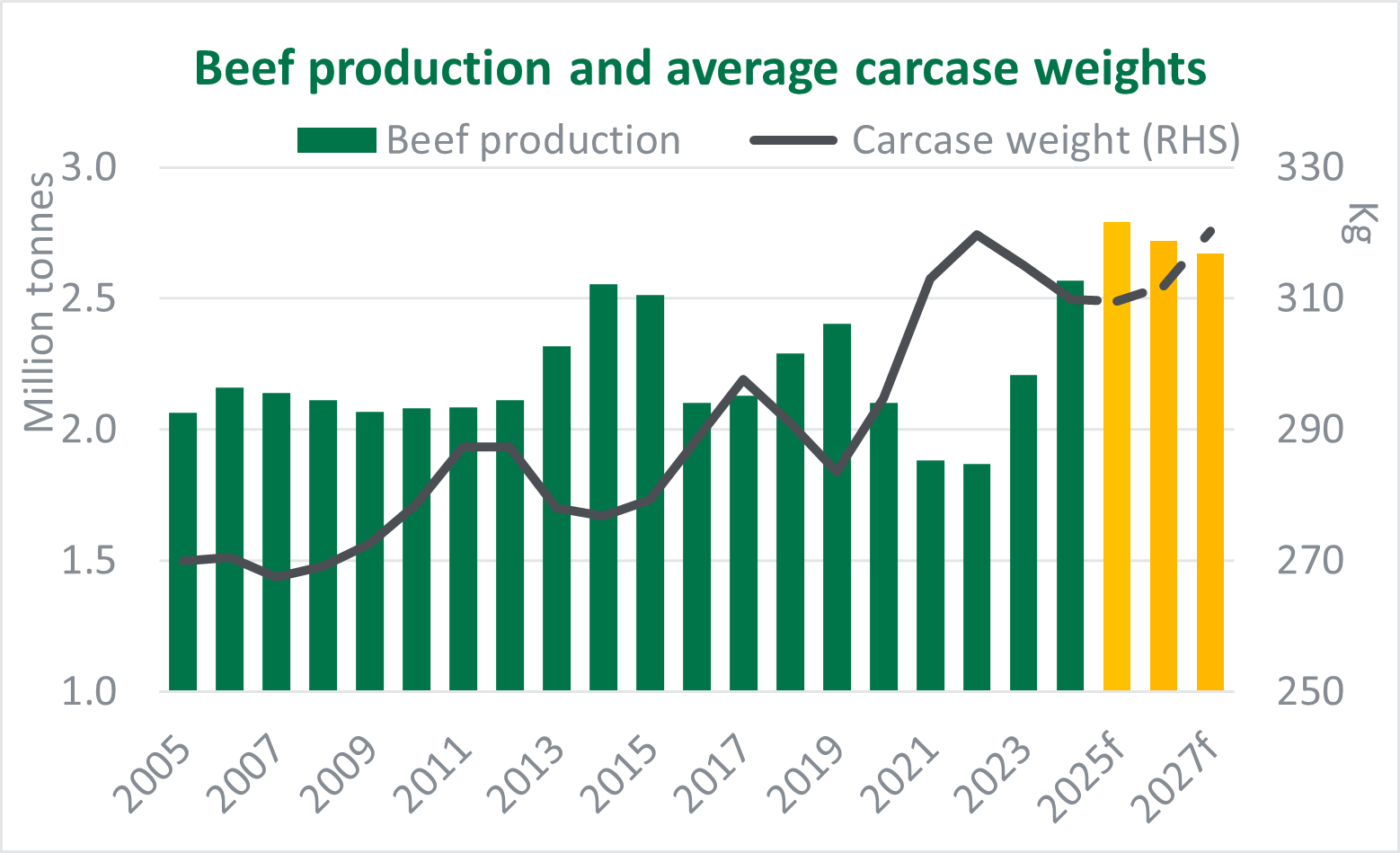
MLA forecasts beef production will reach a record 2.79 million tonnes in the 2025 calendar year before gradually easing over the following two years. It is expected, however, 2026 and 2027 will deliver the second and third highest recorded production years.

Unlike the previous production peak of a decade ago – when severe drought forced large herd liquidation – strong global demand and improved efficiency across the production system are driving the current volumes.

Record production with strong prices

National slaughter is forecast at just over 9 million head in 2025. Other than in 1977, figures were higher only in 2014 and 2015 because of widespread destocking. However, current market conditions are markedly different. In 2025, the National Heavy Steer Indicator is averaging 392¢/kg liveweight (lwt).

This is the third highest annual price on record and 177¢/kg lwt above the 2014 average. This is demonstrating that despite the current high throughput, elevated prices are being sustained because of significant international demand.  

Efficiency gains transforming production

Despite a slightly smaller herd, production is increasing. The national herd is expected to be 31.0 million head in 2025, compared to 31.8 million in 2014, but production will be 9% higher. 

Expanded feedlot capacity and more efficient turn-off systems is enabling younger and heavier cattle turn-off. Average carcase weights are forecast at 310kg in 2025 – 33kg heavier than those in 2014.

Improved efficiencies free pastures for the breeding herd, which, coupled with long-term investment in genetics, has lifted fertility and overall herd productivity. As a result, herd composition has shifted. In 2014, the national herd was 23% calves. By 2024, that figure had increased to 31% – an 8% increase – reflecting higher fertility and a more productive breeding base.

beef prod chart

Sustained turn-off with herd stability

Efficiency gains have enabled Australia to sustain higher than historical turn-off rates and elevated female slaughter without undermining the core breeding herd.

This structural change has reduced the accuracy of traditional indicators and they must now be interpreted in the context of greater efficiency and herd resilience.

Looking ahead

MLA forecasts the herd to remain relatively stable throughout 2026, even as production continues at historically high levels. Assuming average seasonal conditions, the herd is expected to hold steady while delivering the second-largest beef production year ever recorded.

The September projections highlight the industry’s significant evolution. Where record volumes once reflected liquidation, they now reflect efficiency, productivity and Australia’s positioning in a strong global demand context.

Access the September 2025 Cattle Industry Projections here.


The Bottom Line

  • Beef production is projected to hit 2.79m tonnes in 2025, 9% higher than the previous in 2014, despite a smaller herd.

  • Feedlots and genetics are reshaping and increasing herd productivity.

  • Herd composition has shifted with younger cattle supporting higher turn-off.

A look at the implications of El Nino on rainfall

A look at the implications of El Nino on rainfall

The mention of an El Nino has the scribes’ seeking forecasts and projections for agricultural commodities through production to price. This article...

Read More >
Cattle prices lift on back of rainfall across south eastern Australia

Cattle prices lift on back of rainfall across south eastern Australia

There’s plenty happening in cattle markets at the moment, and as always, weather is sitting front and centre.

Read More >
Feedlot capacity and numbers on feed hit new highs

Feedlot capacity and numbers on feed hit new highs

Australia's grain fed beef sector continued to break records in the December quarter - with capacity, utilisation and numbers on feed exceeding...

Read More >