
1 min read

Strong lot feeder purchasing signals sector resilience

Strong lot feeder purchasing signals sector resilience
Pic: AgriShots
Strong lot feeder purchasing signals sector resilience
2:07

The number of lot feeders purchasing cattle has grown substantially in 2025, highlighting strong feedlot activity and continued confidence in the sector. 

Around 50% of yearling steers and heifers are currently being purchased by lot feeders, underscoring their presence in the market over the past two years.

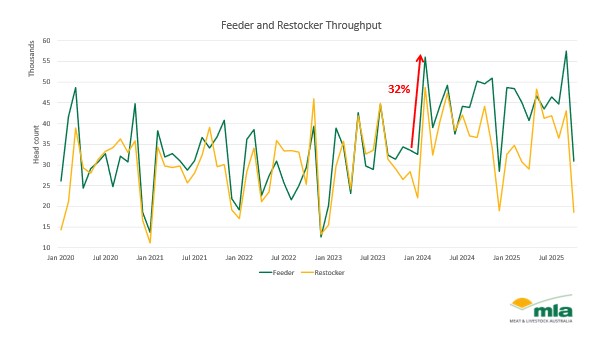
Restockers and lot feeders are often competing for suitable young cattle. When prices are favourable, restockers tend to step in when lot feeders’ buying eases. This reflects producers’ optimism and intention to rebuild herds. This was evident earlier this year when seasonal conditions were more favourable.

In 2024, lot feeder purchases surged sharply, rising 72% from 32,614 head in January to 56,050 head in February. This significant increase has continued in 2025, with total throughput remaining elevated compared to the previous three-year monthly average of 30,940 head.

throughput

The sustained demand from feedlots suggests pens are filling across key regions, particularly in Queensland and NSW. In the last quarter, as of the June 2025 MLA lot feeding brief, feedlot capacity lifted 4.3% to 957,648 head in Queensland. Utilisation reached 95% in NSW and 93% in Queensland.

With feedlots’ limited space and decent cattle numbers available in northern NSW and Queensland, processors and feeders are booked until Christmas. Additionally, with buyers being more selective, the market has seen price adjustments.

Looking ahead, market movements will largely depend on rainfall over the coming months. If seasonal conditions improve in northern NSW, producers will likely hold cattle until after Christmas when processors and feedlots have more space.


The Bottom Line

  • Lot feeder purchases of yearling steers and heifers have increased.
  • Buyers are being more selective due to high feedlot utilisation, combined with limited capacity.
  • Feedlots and processing plants’ space is limited for the remainder of the year.

May rain masks a deeper dry but cattle are moving

May rain masks a deeper dry but cattle are moving

May brought solid rain to much of the eastern seaboard, but the year-to-date picture tells a different story. Across inland NSW, Victoria and SA,...

Read More >
Could this be peak steer supply?

Could this be peak steer supply?

The end of March seems a lifetime ago given what has gone down in cattle markets since. But it is the end of March slaughter and beef production data...

Read More >
Supply in the spotlight: The China rush, grainfed prioritisation and processors keeping up

Supply in the spotlight: The China rush, grainfed prioritisation and processors keeping up

In late May, the Australian Bureau of Statistics (ABS) released the quarter 1 slaughter and production numbers for livestock and in the same week,...

Read More >