
 Matt Dalgleish
Northern rain and the cost of freight
The forecast is looking promising for vast parts of Queensland and Northern NSW for the coming week.If you are looking for rain, of course.Rain will...
The Australian sheep flock has moved into rebuild territory, but the cattle herd is telling a very different story.
The latest female slaughter ratio, or FSR, moved higher again during the June quarter, suggesting that producers are still turning off breeding females at a rate that is inconsistent with a meaningful national herd rebuild. The quarterly FSR increased from 53.1% in Q1 to 55% in Q2, while the annual measure has climbed to around 54%. Both remain comfortably above the 47% level that we use as the broad dividing line between herd liquidation and rebuild.
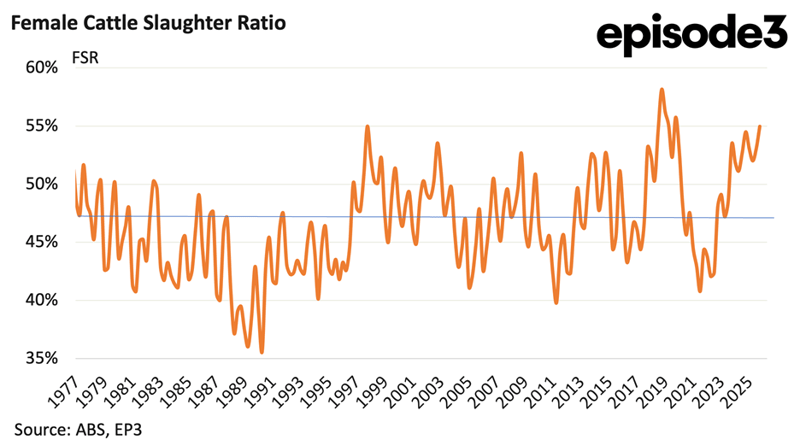
The logic behind the FSR is relatively simple. When producers are rebuilding, more females are retained on farm to produce the next generation of calves. Female slaughter therefore falls as a proportion of total adult cattle slaughter. When seasonal conditions deteriorate, feed becomes scarce or producers simply decide that carrying additional breeding cattle is not worthwhile, more females make their way through the processing system. Historically, an Australian FSR below roughly 47% has been associated with an expanding herd, while sustained readings above that level tend to coincide with contraction. At 54% on an annual basis, Australia remains some distance from a rebuild signal.
There is also an interesting story underneath the national number. Victoria has traditionally operated with a relatively high FSR compared with the northern cattle states, partly reflecting the different structure of its cattle industries and a larger dairy influence. What stands out at present is NSW. Female slaughter in NSW has risen to unusually elevated levels compared with its own history and has moved much closer to Victoria than would normally be expected. That is an important signal. Rather than the national figure simply being dragged higher by Victoria's usual slaughter profile, NSW producers have also been sending a large proportion of females through the system.
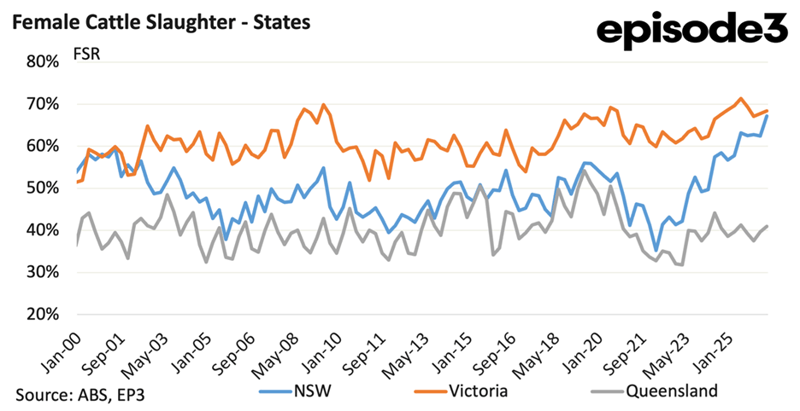
Queensland presents a less dramatic picture than NSW and Victoria, but the broader east coast pattern still isn't one that screams herd retention. That matters because NSW and Queensland account for a substantial part of the Australian breeding herd. A genuine national rebuild is difficult to achieve while large numbers of females continue to leave these regions. The national FSR can move around from quarter to quarter, but for the herd cycle to properly turn we would expect to see female slaughter rates falling more consistently across the major cattle producing states.
Seasonal conditions probably explain part of the reluctance to shift into rebuilding mode. Rainfall deciles for the first half of 2026 show below average conditions across parts of Queensland and NSW, including some important cattle regions. There have certainly been areas receiving reasonable rainfall, but the picture isn't uniformly favourable. High cattle prices are an incentive to retain breeding stock, but price alone cannot manufacture grass. If producers do not have confidence in pasture availability, water or the coming season, selling females while values are strong can remain a perfectly rational decision.
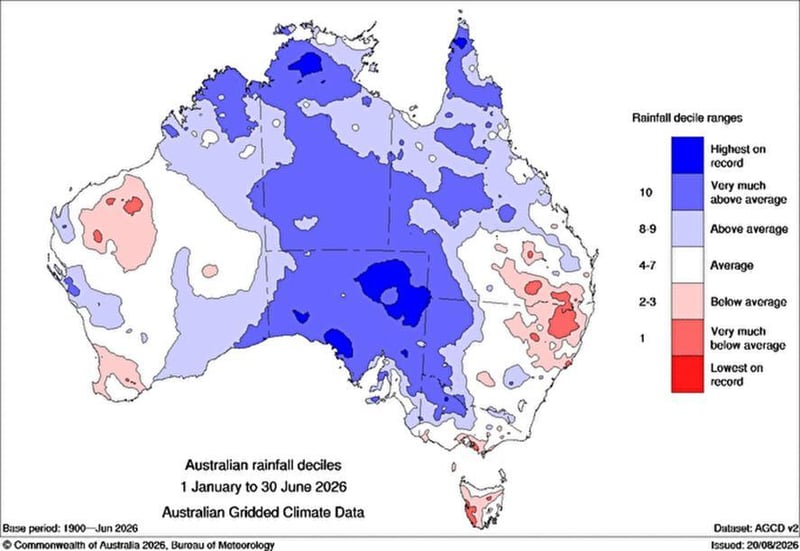
This is where the cattle and sheep cycles have started to diverge. Across much of the major sheep producing country in southern Australia, recent seasonal conditions have been considerably more favourable. This is particularly true for much of western NSW, western Victoria and South Australia. At the same time, both sheep and wool prices have provided producers with a much stronger economic incentive to retain breeding animals. The sheep turnoff ratio has consequently moved into territory more consistent with flock rebuilding earlier than the cattle FSR has done for the herd. There is nothing unusual about the two species moving at different speeds. Their geographic footprints, seasonal exposure and economics are different.
The encouraging part for cattle producers is that the ingredients for a rebuild are not impossible to see. Cattle values remain historically strong, particularly for breeding and restocker animals, and a widespread improvement in seasonal conditions would quickly alter the calculation around retaining females. But the data says that this has not happened yet. Indeed, with the quarterly FSR rising to 55% and the annual ratio around 54%, the female turnoff signal has moved further away from the 47% rebuild threshold rather than towards it.
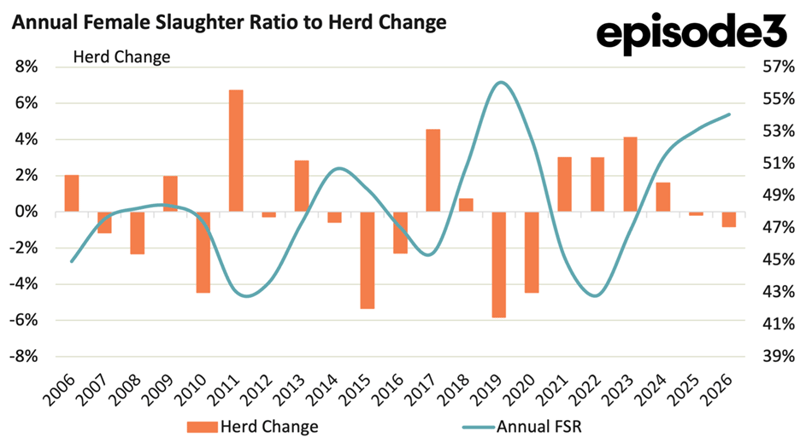
For now, Australia appears to have two livestock cycles travelling on slightly different tracks. Sheep producers have been given the combination of feed and price required to start a rebuild phase. Across the cattle regions of NSW and Queensland, the seasonal confidence required to do the same has been less convincing. The herd rebuild will come eventually, but on the latest slaughter numbers it remains something we are waiting for rather than something that has begun.
Matt Dalgleish is a director of Episode3.net and co-host of the Agwatchers podcast.

The forecast is looking promising for vast parts of Queensland and Northern NSW for the coming week.If you are looking for rain, of course.Rain will...
Grass is setting the pace in the cattle market, with restockers outbidding feedlots and processors on AuctionsPlus last week.
 Natasha Lobban: Oct 8, 2026
AuctionsPlus has recorded its biggest September for new season lambs in the past decade, with 218,871 head offered across the month.