
The United States has extended its lead away for the other three major beef export markets. The 25,761 tonnes of beef shipped to the US was the highest monthly volume since June 2020. Total Australian beef exports were the highest they have been since December 2019 and are expected to stay elevated.


Key Points

  • US extends its lead as the top beef export destination for August and the year-to-date

  • Total beef exports now well above the five-year average and expected to continue that way

  • Asian export markets remain flat with little upside in the short-term


Slaughter numbers have reached their highest level since May 2020 at 127,337 head in the week ending 1 September.

The Australian Dollar is currently at about US64c, the lowest point since May 2022 other than a quick drop at the end of 2022. The lower dollar combined with low domestic cattle prices has greatly improved the competitiveness of Australian beef in the global market, particularly in the US import market.

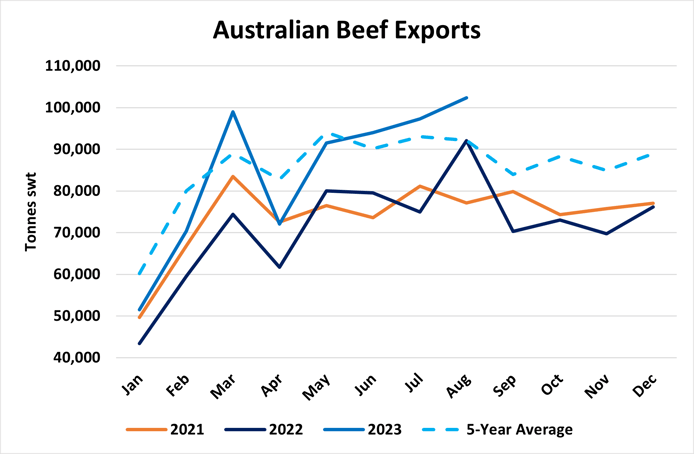
Export volumes totalled 102,351 tonnes shipped weight in August, up 5% on July 2023 and up 11% on August 2022.

Figure 1 Beef-1

Figure 1: Monthly beef exports 2021 – August 2023. Source: DAFF

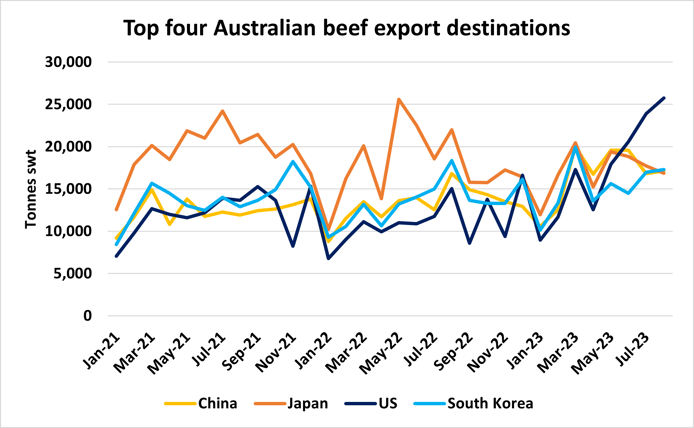
The US was the top export destination for August by a long way, with 25,761t shipped, 71% more than last year. South Korea, China and Japan were all flat from July to August with 17,304t shipped to South Korea, 17,114t shipped to China and 16,868t shipped to Japan. These volumes are flat to lower than this time last year for all three markets.

Figure 2 Beef-2

Figure 2: Monthly beef exports by destination 2021 – August 2023. Source: DAFF

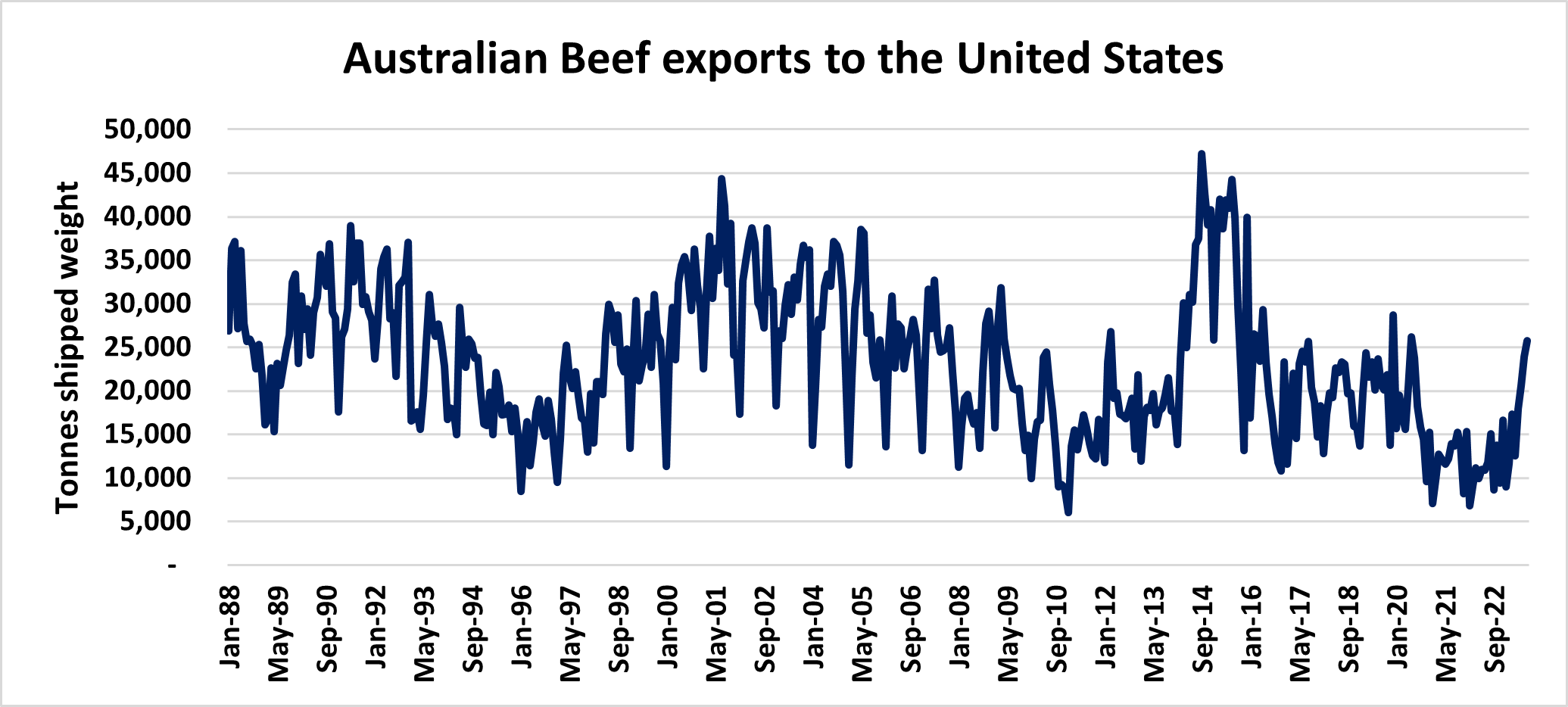
There is a clear cyclical pattern in Australian beef exports to the US as seen in Figure 3. This is driven by higher production in Australia and lower production in the US and vice versa. Exports to the US are expected to soar in the next few months, as US production declines and Australian production continues to rise.

Figure 3 Beef

Figure 3: Monthly beef exports to the United States, 1988 – August 2023


New call-to-action

Global beef prices and local cattle prices moving in opposite directions

Global beef prices and local cattle prices moving in opposite directions

The local cattle market has found another gear since the big turn off across southern Queensland and northern NSW eased entering May, as some late...

Read More >
National herd grows as grassfed bullock numbers potentially impact future feeder steer supply

National herd grows as grassfed bullock numbers potentially impact future feeder steer supply

Meat & Livestock Australia has released the April wave of its Beef Producer Intentions Survey (BPIS) report, which details key underlying changes in...

Read More >
Testing trading scenarios

Testing trading scenarios

Last week we looked at restoration of restocker demand in cattle markets, which, along with tightening supply, has driven the young cattle market to...

Read More >