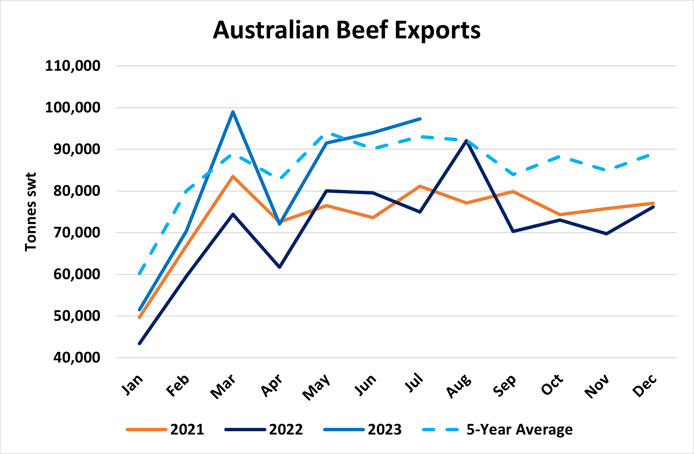

The United States has split from the pack and is screaming ahead with beef export volumes for the month of July double what it was this time last year. Total Australian beef exports remained above the five-year average in July and are expected to stay elevated for the rest of the year.


Key Points

  • US extends its lead as top beef export destination for July

  • Total beef exports now comfortably above the five-year average and expected to continue that way

  • China and South Korea also increasing shipments of Australian beef


Higher slaughter numbers in Australia, greater cost competitiveness in global markets and lower production of beef in the US are all contributing to the promising results. Export volumes totalled 97,305 tonnes shipped weight in July, up 4% on June 2023, up 30% on July 2022 and up 5% on the five-year average.

Figure 1 Bef

Figure 1: Monthly beef exports 2021 – July 2023. Source: DAFF

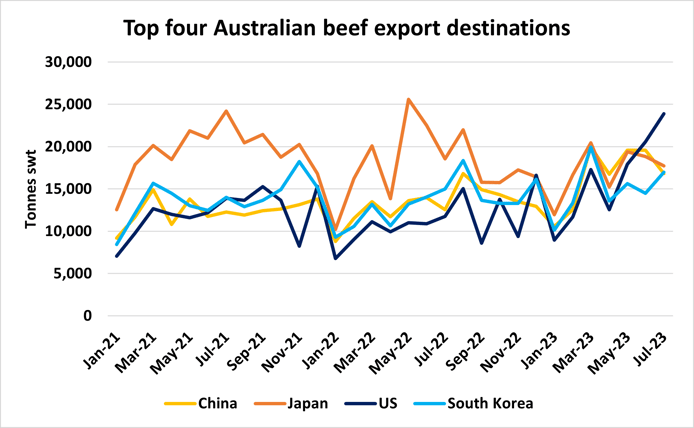
The US was the top export destination for July by a long way, with 23,910t shipped, 103% more than last year. China and Japan both dropped off the pace from June to July with 16,807t shipped to China and 17,732t shipped to Japan.

These volumes are still 34% higher than last year for China, whereas export volumes to Japan are down 4% year-on-year. South Korea on the other hand caught up lost ground with 16,960t shipped for the month, a 13% increase on this time last year.

Figure 2 Beef-1

Figure 2: Monthly beef exports by destination 2021 – July 2023. Source: DAFF

The balance of export beef demand, driven by lower US production and increased supply of cattle driven by seasonal conditions, will be the most important factor behind price changes going forward.

The relatively low price of Australian beef compared to global competitors will provide a strong floor to domestic cattle prices. However, a sharp increase in supply of slaughter cattle will pose some downside risk.


New call-to-action

Global beef prices and local cattle prices moving in opposite directions

Global beef prices and local cattle prices moving in opposite directions

The local cattle market has found another gear since the big turn off across southern Queensland and northern NSW eased entering May, as some late...

Read More >
National herd grows as grassfed bullock numbers potentially impact future feeder steer supply

National herd grows as grassfed bullock numbers potentially impact future feeder steer supply

Meat & Livestock Australia has released the April wave of its Beef Producer Intentions Survey (BPIS) report, which details key underlying changes in...

Read More >
Testing trading scenarios

Testing trading scenarios

Last week we looked at restoration of restocker demand in cattle markets, which, along with tightening supply, has driven the young cattle market to...

Read More >