El Niño is officially here. What does it mean?
The Bureau of Meteorology (BOM) has this afternoon officially confirmed that the El Niño–Southern Oscillation (ENSO) is now in an El Niño phase - and...
The Bureau of Meteorology (BOM) has this afternoon officially confirmed that the El Niño–Southern Oscillation (ENSO) is now in an El Niño phase - and for many livestock producers, that word carries weight.
But standing on-farm in June, it's hard to feel the alarm. It's been a pretty normal start to winter here, just a touch warmer than usual. I even got bogged the other day.
The BOM has been reporting signs of El Niño developing since March and officially pulled the trigger on Tuesday afternoon.
it's long-range forecast for July to September points to rainfall likely to be below average across parts of southern and eastern Australia and temperatures likely to be above average in most areas, except parts of the north.
That's consistent with what El Niño typically delivers in winter and spring - drier, warmer conditions across much of the eastern half of the country, with increased frost risk where skies clear out.
During El Niño, the Pacific is likely to be extending a dry influence on our rainfall patterns. However, other factors can either boost or reduce this effect.
But the BOM is careful to note that forecasts can't predict specific events in advance. An east coast low can still bring significant rainfall in winter regardless of what ENSO is doing. And the Indian Ocean Dipole, another major climate driver, is currently neutral, though models suggest it could shift positive during winter. If that happens alongside El Niño, the drying signal strengthens, particularly across southern and eastern Australia.
The caveats are real, and there are a lot of them.
The last El Niño was a moderate to strong event that developed in spring 2023 and lasted into early 2024. You'll remember this as the event that completely crashed Australia's livestock market.
While August to October 2023 was Australia's driest three-month period on record, a strong positive Indian Ocean Dipole (IOD) also contributed to the dry conditions.
You may also remember that El Niño had less influence from late 2023. Storms along the east coast and four tropical cyclones brought above average rainfall to widespread areas during the summer months.
This experience taught producers that El Niño doesn't always mean drought - no matter what headlines are pushing. We've now, as a collective, learned that the forecast is more complicated than that and I invite you to take a deep breath when reading the inflammatory metropolitan media headlines I'm sure have started already today.
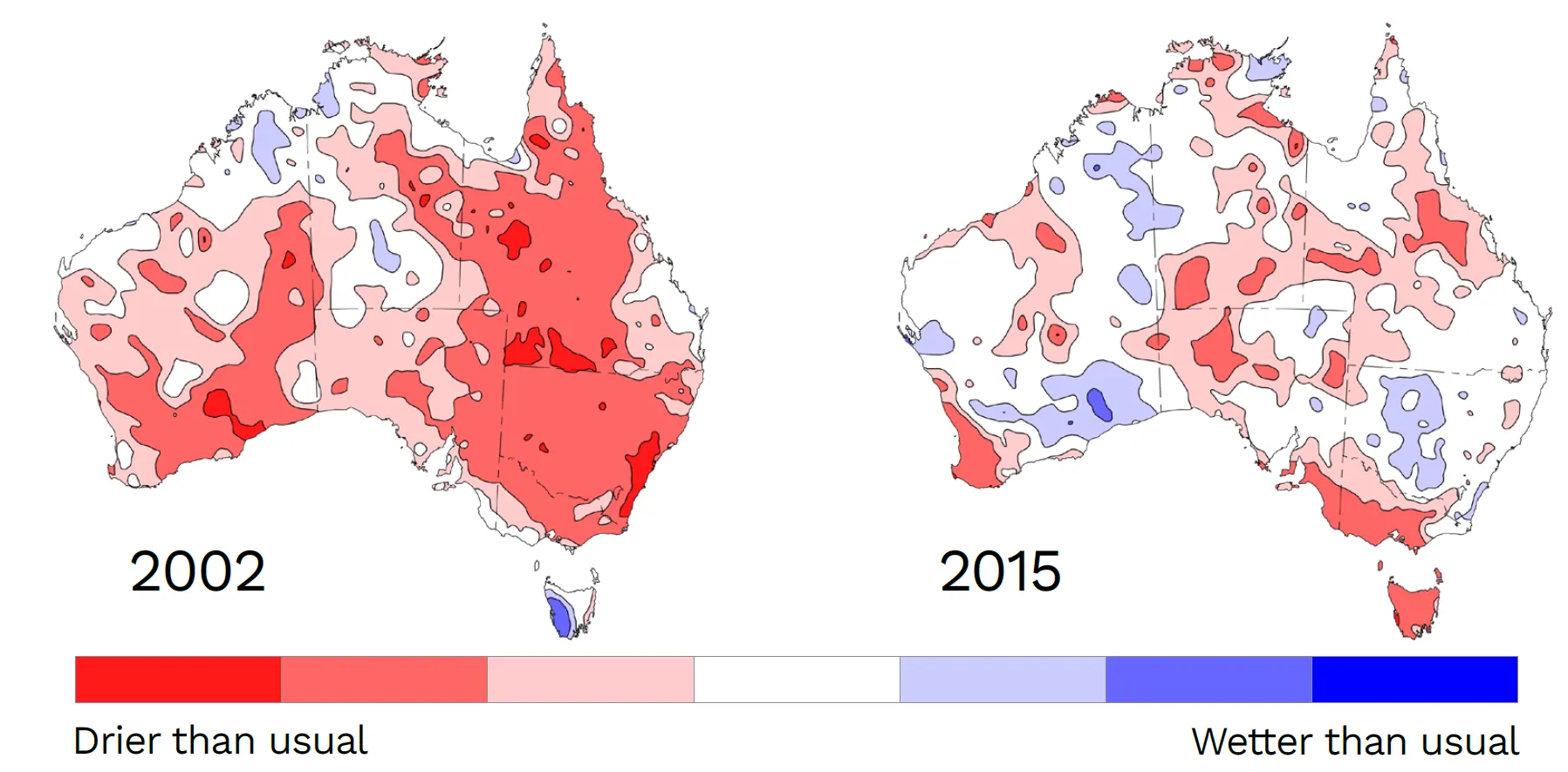
What is known is that no two events play out the same way. The BOM's own comparison of 2002 versus 2015 makes that clear. The year 2002 brought widespread dry conditions across most of the eastern half of the country, while 2015 was far more mixed. The current event is expected to be strong to very strong based on sea surface temperatures in the tropical Pacific, but event strength doesn't always translate directly into on-ground impact.
Whatever the season brings, grass fever has done the talking in recent weeks. Last week's cattle results on AuctionsPlus showed continued upward momentum, with the AuctionsPlus Young Cattle Indicator now sitting at 547c/kg LW. Just five weeks earlier it was as low as $461c/kg LW. That means in just five weeks it has lifted 24.5% - and the key ingredient has been widespread rain.
It's hard not to feel confident when prices are running like that. But a reality check landed today alongside the seasonal forecast.
Rabobank's quarter two Rural Confidence Survey, released this morning, found national agricultural sentiment at its lowest point since November 2006, dropping to a net reading of -48%. More than half of Australian farmers expect conditions in the agricultural economy to worsen over the next 12 months, with rising input costs, cited by 60% of respondents, the leading concern. Only one in 10 reported a positive outlook for the year ahead.
Rabobank group executive for Country Banking Australia Marcel van Doremaele noted that around a third of farmers flagged drought as a concern, though that had eased somewhat since the previous quarter. He also pointed to recent rainfall in a number of states as a positive, particularly for dry areas such as the Central West of New South Wales.
It's a useful reminder that current price strength and broader producer confidence are not always the same thing and that input cost pressures are running hard regardless of what the season does.
It's too early to say what summer will look like, the BOM says the outlook will become clearer by late spring.
For now, the message is the same as it's been through recent seasons: watch conditions closely, sharpen contingency plans where needed, and don't let confidence in current prices get ahead of feed budgets.
Hopefully you get the rain you need, when you need it most, and if you're in the market for some cattle to take advantage of the season that's here right now in front of us, there's some handy lots on the box this Friday. You should check them out.
Natasha Lobban is the Content Manager at AuctionsPlus, bringing more than 20 years of experience in agricultural media and communications. Based on a farm in North East Victoria, she combines deep industry knowledge with a passion for keeping producers informed and telling the stories of the people behind Australian agriculture.
Posts By Tag
The Bureau of Meteorology (BOM) has this afternoon officially confirmed that the El Niño–Southern Oscillation (ENSO) is now in an El Niño phase - and...
A substantial cloud band has generated high levels of rainfall across WA, not unusual as some suggest for this time of year, with this being the...
The weather pattern settles for the long weekend after many areas saw beneficial rainfall courtesy of a low pressure system that swept from west to...