
 Matt Dalgleish
Northern rain and the cost of freight
 Andrew Woods: Oct 14, 2026
The forecast is looking promising for vast parts of Queensland and Northern NSW for the coming week.If you are looking for rain, of course.Rain will...
Australia’s feedlot sector experienced a clear recalibration during 2025, driven by shifts in Wagyu production, feeding economics, and market premiums.
The decline in average days on feed marked the most visible indicator of this adjustment, with subsequent changes in Wagyu numbers, feeding duration profiles, and price signals reinforcing a consistent and interconnected narrative across the industry.
The most immediate signal of change was the reduction in average days on feed. As shown in the Grainfed Average Days On Feed chart, feeding durations declined from 164 days in 2024 to 155 days by the end of 2025, according to the Australian Lot Feeders' Association (ALFA) and Meat & Livestock Australia (MLA) feedlot survey for the December quarter. 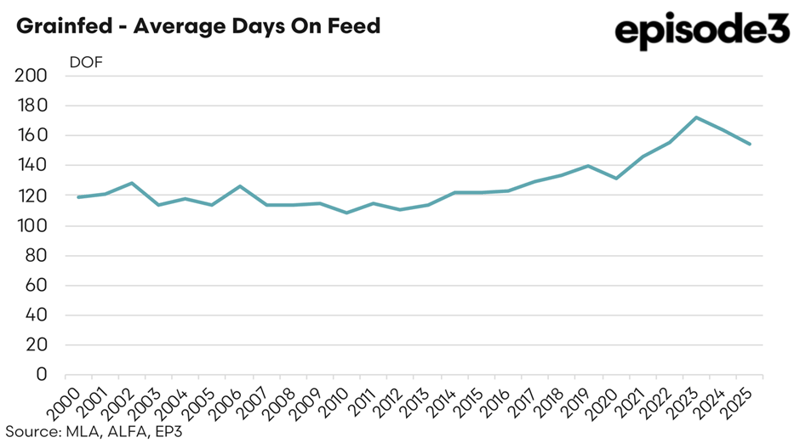
While still historically elevated, this decline represents a moderation from the record levels reached in recent years. The broader trend highlights the structural evolution of Australia’s grainfed sector, where average feeding periods have steadily increased from around 120 days in the early 2000s. This upward shift has been largely underpinned by the expansion of long-fed Wagyu and premium beef programs. The easing recorded in 2025 therefore reflects a cyclical adjustment rather than a structural reversal, signalling a recalibration in response to changing economic conditions.
A key driver behind the reduction in average days on feed was the decline in Wagyu numbers within Australian feedlots. EP3 estimates indicate that Wagyu on feed fell from a record level exceeding 300,000 head in 2024 to approximately 227,000 head by the end of 2025. This represents a decline of around 25% over the year, following a substantial 48% increase during 2024. Such volatility underscores the sensitivity of long-fed production systems to shifts in market incentives. As Wagyu cattle typically remain on feed for extended periods, any contraction in this segment has a pronounced impact on overall feedlot metrics, particularly average days on feed. The adjustment observed during 2025 highlights how rapidly producers and lot feeders respond to changing profitability signals.
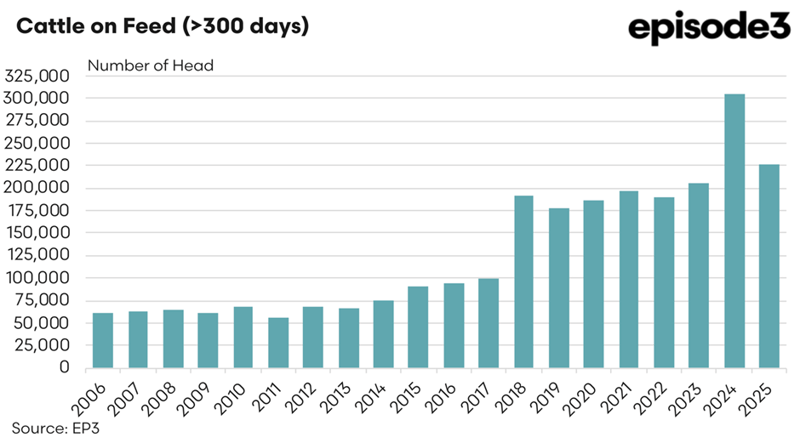
The ALFA and MLA survey data provides further confirmation of this trend. The Cattle on Feed greater than 300 days chart shows a clear decline in the number of long-fed cattle during 2025, mirroring the reduction in Wagyu numbers estimated by EP3. After reaching record highs in 2024, the number of cattle on feed for more than 300 days fell noticeably, reinforcing the conclusion that the decline in average days on feed was driven primarily by a pullback in long-fed Wagyu production.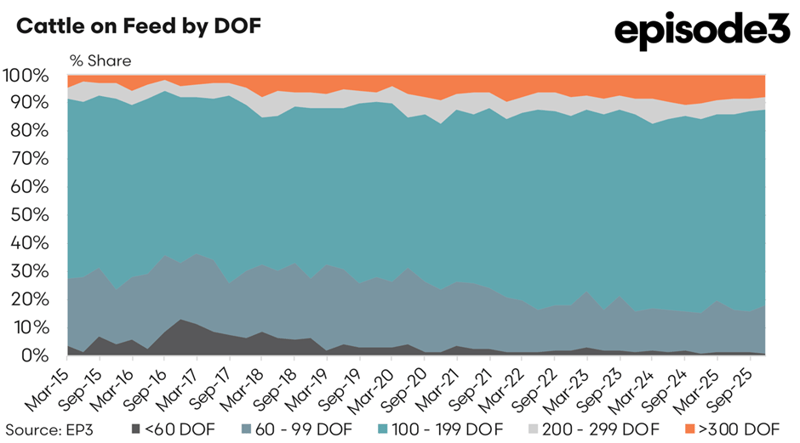
This alignment is further supported by the annual percentage change chart for cattle exceeding 300 days on feed, which illustrates a sharp contraction in 2025 following strong growth in the preceding year. The data highlights the cyclical nature of premium beef production, where extended feeding programs expand rapidly during periods of favourable margins and contract when profitability comes under pressure.
Additional insight is provided by the Cattle on Feed by DOF chart, which shows the distribution of feeding durations across Australian feedlots. Cattle fed between 100 and 199 days dominate the system, while the share of cattle exceeding 300 days on feed remains relatively small but highly influential. Changes within this long-fed category have a disproportionate impact on overall feeding averages. The decline in the greater than 300 day segment during 2025 closely mirrors the fall in Wagyu numbers estimated by EP3, reinforcing the conclusion that Wagyu production trends were the primary factor behind the reduction in average days on feed.
The underlying catalyst for this adjustment was a shift in Wagyu price premiums. The Average F1 Wagyu Premiums to NYCI chart demonstrates the volatility experienced throughout 2025. The long-term average premium for F1 Wagyu between 2016 and 2025 stood at 32%. However, during the second quarter of 2025, premiums contracted sharply to just 2%, effectively bringing F1 Wagyu prices into alignment with non Wagyu cattle. This compression significantly eroded the financial incentive to commit cattle to extended feeding programs, prompting producers and feedlot operators to reassess placements and feeding durations.
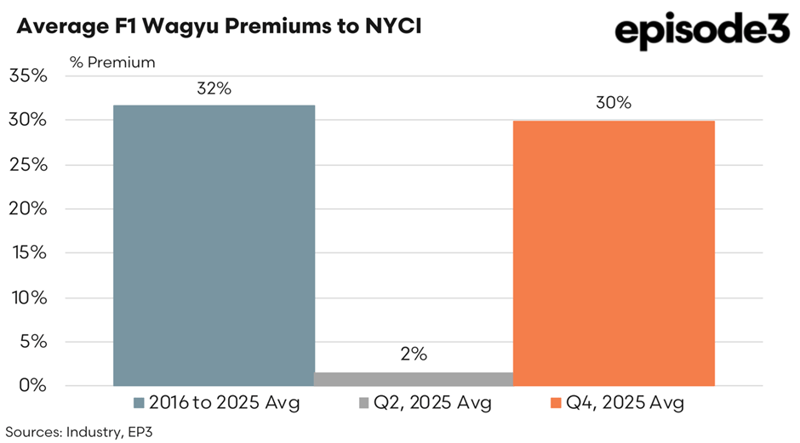
By the fourth quarter of 2025, premiums had rebounded to approximately 30%, returning to levels close to the long-term average. While this recovery restored confidence in the sector, it came too late to prevent a contraction in Wagyu numbers and a corresponding reduction in long-fed cattle throughout the year. The timing of these price movements explains why average days on feed declined in 2025, despite improved market conditions toward the year’s end.
The Wagyu price premiums are sourced from a combination of AuctionPlus data, direct industry input and results from the Episode3.net survey undertaken at the end of each quarter. The Q1, 2026 Wagyu survey is now open for industry participants to provide pricing data achieved over the January to March period in 2026. Price data information supplied will be aggregated and averaged to provide indicators of Wagyu pricing.
Collectively, the charts presented in this analysis provide a clear and cohesive story. The decline in average days on feed from 164 days in 2024 to 155 days in 2025 was driven by a reduction in Wagyu held in Australian feedlots. EP3 estimates of Wagyu numbers align closely with ALFA and MLA survey data showing fewer cattle on feed for more than 300 days. These structural adjustments were, in turn, influenced by a sharp contraction in Wagyu premiums during the middle of 2025, followed by a recovery later in the year.
The events of 2025 highlight the responsiveness of Australia’s feedlot sector to market signals. As premiums stabilise and global demand for high-quality beef remains firm, the long-fed segment is likely to regain momentum. For now, the data illustrates an industry adjusting rationally to shifting economic conditions, reinforcing the central role of profitability in shaping feedlot production decisions.
Matt Dalgleish is a director of Episode3.net and co-host of the Agwatchers podcast.

 Andrew Woods: Oct 14, 2026
The forecast is looking promising for vast parts of Queensland and Northern NSW for the coming week.If you are looking for rain, of course.Rain will...
Grass is setting the pace in the cattle market, with restockers outbidding feedlots and processors on AuctionsPlus last week.
 Natasha Lobban: Oct 8, 2026
AuctionsPlus has recorded its biggest September for new season lambs in the past decade, with 218,871 head offered across the month.