
Year-to-date rainfall deficiency areas eased in severity in some areas of southern Australia but expanded in parts of western NSW, according to the Bureau of Meteorology's latest Drought Statement, issued on Monday. 

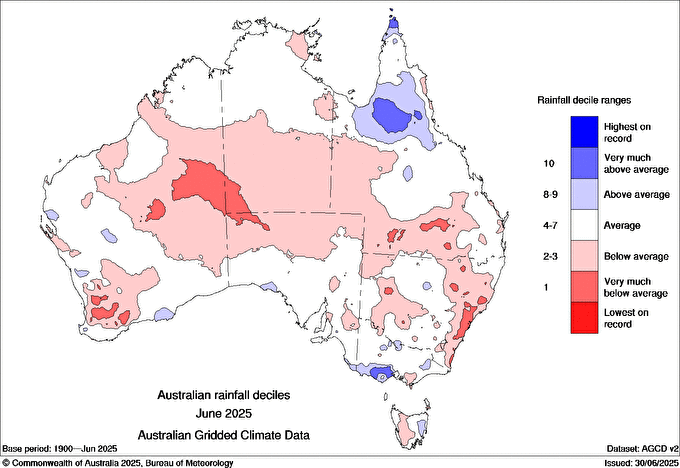
June rainfall was below average across much of Australia and above average across parts of northern Queensland and small areas of southern Australia.

Decile map june rainfall

Within the statement, it shows that for the 27-month period since April 2023, which includes the last two southern cool seasons, areas with severe or serious rainfall deficiencies (rainfall totals in the lowest 5% or 10% of periods, respectively, since 1900) extend across large areas in the south-west and west of Western Australia, agricultural regions of South Australia, south-western Victoria and small areas in the east, parts of the west and east coasts of Tasmania, the Bass Strait islands, and some inland areas. A small area of alpine north-eastern Victoria into south-eastern New South Wales is also included.

READ THIS WEEK'S FORECAST FROM JANE BUNN: Next big weather system is a widespread cold outbreak

June rainfall was above to very much above average for parts of northern Queensland, southern Victoria, scattered areas in the south-west of Western Australia and parts of eastern Tasmania.

Areas with lowest on record rainfall include a large region extending inland around Perth in Western Australia, parts of the Yorke Peninsula and Mid North districts in South Australia and the coastline from Warrnambool to Cape Otway in Victoria.

Since May, there has been a slight decrease in the area of lowest on record rainfall. However, the extent of the rainfall deficiency areas is largely unchanged.

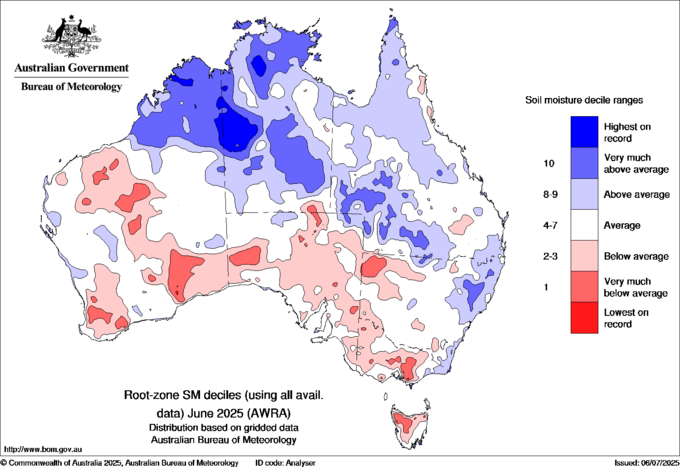
Root zone SM deciles

Soil moisture deficits have eased in severity but persist in the south and west. 

There has also been high evaporative stress across much of southern Australia

Streamflow was below average at many sites across southern and western Australia, with some locations recording their lowest June streamflow on record.

Some storages in the southern states have declined by up to 50% compared to this time last year.

Urban water storages in Adelaide and Perth remain below 40% of capacity, following prolonged rainfall deficiencies.

Meanwhile, the Bureau also released its Climate Outlook for July to October last week which revealed rainfall is likely to be above average for parts of the interior and east, with roughly equal chances of being above, below or near-average for western and south-eastern Australia.

It also shows that warmer than average days are likely across Australia, with an increased chance of unusually high daytime temperatures in parts of the far north, west and south-east.

Warmer than average nights are likely to very likely across much of Australia, with an increased chance of unusually high overnight temperatures.


The Bottom Line

  • June rainfall was below average across much of Australia and above average across parts of northern Queensland and small areas of southern Australia.

  • Soil moisture deficits have eased in severity but persist in the south and west. 

  • Climate Outlook for July to October forecasts rainfall is likely to be above average for parts of the interior and east, with roughly equal chances of being above, below or near-average for western and south-eastern Australia.


Significant rain spreading across the southeast to begin the weekend

Significant rain spreading across the southeast to begin the weekend

The leftover moisture from Cyclone Fina is meeting up with a trough over the centre of the country and it is set to spread significant rain...

Read More >
A cyclone for the Top End, good weather for the cricket and a rain system in the southeast

A cyclone for the Top End, good weather for the cricket and a rain system in the southeast

We have Cyclone Fina in the Top End this weekend, great conditions for cricket in Perth and a rain system crossing the southeast.

Read More >
Negative IOD coming to an end, but the increased wet weather is not

Negative IOD coming to an end, but the increased wet weather is not

Across Friday and the weekend we have a significant weather system affecting the Northern Territory, Queensland and northeast NSW.

Read More >